Cart 0

Qajar Dress History · Object Reading · Textile Authority
A court garment can be read like architecture: cut, surface, weight, shine, and social intention.
A Qajar jacket is never merely a covering for the body. It is a compact visual system in which textile luxury, courtly self-fashioning, imported materials, local craft intelligence, and pictorial display meet. To study it well, one must move between the hand of the tailor, the eye of the painter, the authority of rank, and the afterlife of garments in museum collections and the art market.
Reading the jacket as an intentional form
The Qajar period produced one of the most visually legible dress cultures in Iranian history. Jackets, coats, robes, waist garments, trousers, headgear, slippers, sashes, and jewels worked together to construct a bodily image that could be read by others. In this world, a jacket was not a neutral object placed over the torso. It framed the chest, sharpened or softened the shoulder line, controlled the rhythm of the sleeve, organized the relationship between textile surface and human posture, and helped turn the wearer into a social image.
The phrase “designed object” is useful because it resists two common simplifications. First, it prevents us from treating historical dress only as costume, as if garments existed merely to illustrate a period. Second, it prevents us from turning dress into abstract symbolism detached from the body. A Qajar jacket is simultaneously material, aesthetic, social, and economic. Its cut tells us how the body was imagined. Its textile tells us how wealth and taste were staged. Its ornament tells us how surface became authority. Its survival in collections tells us how certain garments became collectible evidence of a lost visual order.
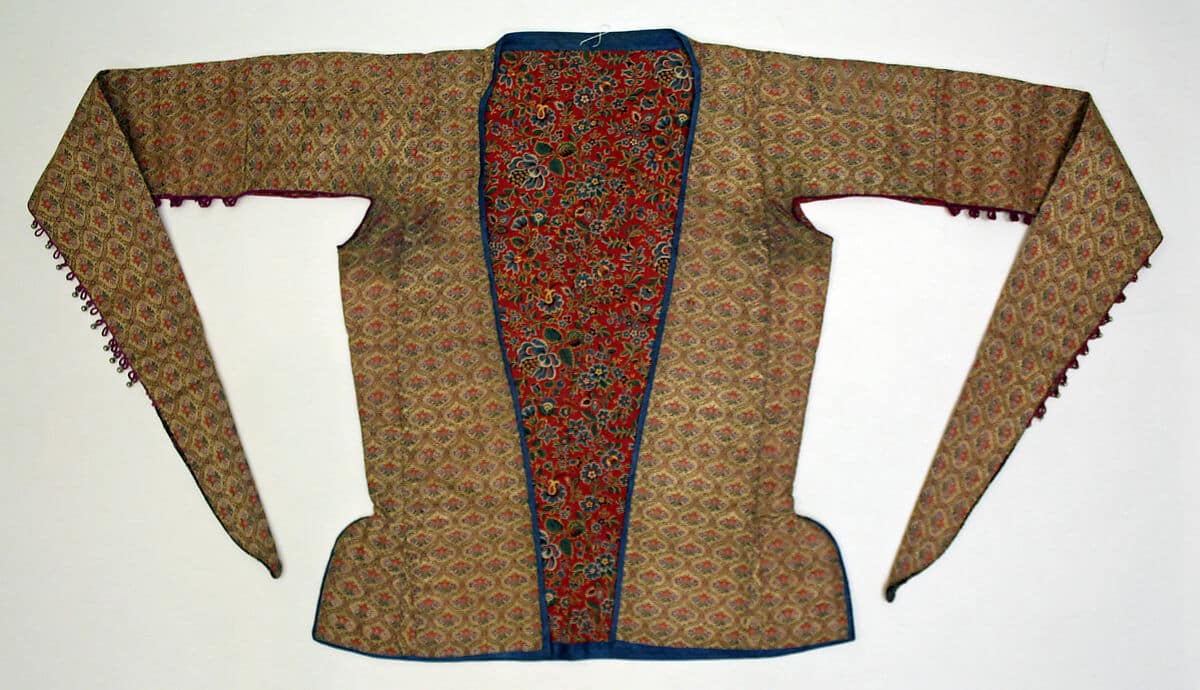
Surviving Iranian coats in institutional collections, including brocaded examples in the Metropolitan Museum of Art, remind us that the jacket must be studied with the same seriousness given to painting, metalwork, manuscript design, and architecture. Its artistic intelligence lies in proportion, material contrast, and the disciplined orchestration of visual power.
Visual System
Ivory ground, burgundy authority, metal-thread light, archival shadow
Ivory
Paper, lining, conservation light
Paper, lining, conservation light
Burgundy
Court depth, velvet resonance
Court depth, velvet resonance
Faded gold
Metal thread, prestige, reflection
Metal thread, prestige, reflection
Charcoal
Ink, outline, silhouette discipline
Ink, outline, silhouette discipline
Sepia
Photographic memory, aged textile
Photographic memory, aged textile
This palette is not decorative fantasy. It translates the visual atmosphere through which a Qajar jacket often reaches us today: the cream of aged cotton and paper, the deep reds of courtly display, the restrained glitter of metal-wrapped thread, the dark contour of pictorial outline, and the sepia tone of photographic and archival survival.
Historical ground: Qajar display and the politics of surface
Qajar Iran, broadly from the late eighteenth century to the early twentieth century, was a world of intensified visual performance. Court portraiture, lacquer painting, photography, diplomatic ceremony, and urban sociability all changed the way elite bodies appeared. The jacket belonged to this larger ecology of visibility. It could be worn in courtly, urban, ceremonial, domestic, or pictorial contexts, and its meaning shifted according to wearer, setting, material, and representation.
Dress historians must be careful not to impose one rigid narrative on the period. Qajar clothing was not a single uniform. It included changing forms of men’s and women’s dress, regional variations, class distinctions, imported cloth, local weaving, courtly magnificence, domestic refinement, and later encounters with photography and European tailoring. The value of Encyclopaedia Iranica’s discussion of Safavid and Qajar clothing is that it places garments inside a longer Iranian history of layered dress, textile abundance, and shifting evidence from travel accounts, paintings, and surviving objects.
The Qajar jacket became important because it occupied the middle zone between intimate body and public appearance. Unlike a textile panel, it had to negotiate movement. Unlike a painting, it had to submit to gravity, sweat, gesture, storage, repair, and wear. Unlike a jewel, it spread value across surface rather than concentrating it at one point. It was a wearable field of design.
Garment Anatomy Board
How the form organizes the body
Not a flat textile, but a shaped argument
The jacket’s design begins with the torso. The front opening, the vertical line of closure, the placement of borders, and the handling of sleeve width create a controlled reading of the body. A central opening can become a line of authority. A patterned border can sharpen the frame. A sleeve can signal ease, rank, gendered style, or ceremonial dignity depending on scale and material.
This schematic panel is not a reconstruction of one garment. It is a reading tool. The burgundy sides indicate visual density; the gold strips suggest prestige borders; the pale field evokes the visible chest or textile ground; the dark sleeve masses remind us that Qajar dress often used the arm as a stage for proportion, gesture, and display.
Silhouette, proportion, and the disciplined surface
The most revealing question is not simply “What was it made of?” but “How did it ask to be seen?” A Qajar jacket might shorten, lengthen, narrow, broaden, frame, or dramatize the upper body. Its design logic depends on relationships: shoulder to sleeve, chest to opening, textile field to border, outer fabric to lining, matte ground to reflective thread. Even when the cut appears simple, the garment’s visual intelligence is complex because the jacket converts the body into a readable surface.
Surface was not superficial in Qajar visual culture. It was a primary language of status and beauty. The same period that produced striking royal and noble portraits also produced garments capable of holding light as a form of authority. The Smithsonian’s National Museum of Asian Art exhibition The Prince and the Shah is useful here because it shows how Qajar representation transformed royalty and nobility through paintings, lacquerwares, and photographs. A jacket in such a visual world was never innocent: it could help produce the very image that portraiture preserved.
The jacket also mediates between fixed image and lived body. In a portrait, the garment may appear perfectly ordered. In life, it moved, creased, reflected unevenly, and responded to posture. A well-designed jacket anticipates this instability. Borders hold the outline. Heavier cloth lends structure. Metallic thread catches movement. Embroidery concentrates attention. The garment is therefore both composition and performance.
Textile Hierarchy
Material as rank, memory, and design intelligence
Velvet depth
Velvet suggests density, touch, and absorbed light. In an elite context, it can make the body appear slower, heavier, and more ceremonially present.
Metal thread
Metal-wrapped thread turns light into ornament. Its value is not only monetary; it changes how the garment behaves under candlelight, daylight, and painted representation.
Cotton and lining
Lining is the hidden architecture of comfort and durability. It reveals that even public splendor depends on private engineering.
Brocaded field
Brocade distributes prestige across the surface. It makes the jacket less like a plain garment and more like a portable architectural wall.
Fabric, trade, and the ethics of looking closely
The Qajar jacket also opens a history of production and exchange. Silk, cotton, wool, velvet, brocade, metal thread, printed cloth, and embroidery cannot be separated from labor, trade routes, workshop practice, and the changing availability of imported materials. The Victoria and Albert Museum’s publication record on Iranian textiles points to the exceptional importance of Qajar textile production and the richness of woven, printed, and embroidered fabrics associated with garments and furnishings.
Looking closely is an ethical method. A jacket should not be admired only for exotic beauty or antiquarian charm. Its value lies in the intelligence of makers whose names are often absent from labels: weavers, dyers, embroiderers, cutters, finishers, patrons, merchants, and wearers. The object carries their decisions. A seam may record economy. A border may reveal planning. Wear at the cuff may reveal repeated gesture. A repair may reveal affection, scarcity, or continued use.
For contemporary designers, this matters profoundly. Heritage is not a pattern bank from which motifs can be taken without thought. The Qajar jacket teaches that form, material, and social context must be studied together. Ethical revival begins with reading the garment as a whole system rather than isolating ornament from the life that produced it.
Archive Wall
Four ways a jacket survives after use
As garment
It survives as cut cloth, seam, lining, stain, repair, weight, and material evidence. This is the most physical life of the object.
As image
It survives in painting and photography, where cloth becomes posture, rank, character, and a controlled visual statement.
As catalogue record
It becomes date, medium, geography, accession number, provenance, and classification—useful but never complete.
As market object
It enters the world of rarity, condition, provenance, exhibition history, cultural desire, and collecting taste.
Portraiture, photography, and the jacket as visual evidence
Many readers first encounter Qajar dress through portraits rather than garments. This matters because painted and photographic images do not simply record clothing; they edit it. They emphasize frontality, rank, facial authority, textile brightness, and the theatrical arrangement of the body. The jacket appears as part of a broader visual contract between sitter, artist, patron, and viewer.
A portrait such as Ahmad Shah Qajar and his Cabinet at the National Museum of Asian Art shows how garments, posture, seating, and political visibility form a single visual language. Clothing in such contexts is not background detail. It is evidence of how power wished to appear: ordered, dignified, legible, and materially distinguished.
This is why the jacket must be read against the history of Qajar art. The period’s visual culture is often described through its color, display, and theatrical immediacy, and Iranica’s account of Qajar art and architecture helps frame that atmosphere. The jacket belongs to the same appetite for surface intensity and visual command. It is a garment, but also a compositional device.
How to Read the Object
A practical guide for designers, collectors, and researchers
Start with proportion
Observe length, shoulder width, sleeve rhythm, and front opening before describing decoration. Proportion is the garment’s first argument.
Then examine surface
Ask whether ornament follows the cut, resists it, frames it, or overwhelms it. Good object reading connects textile pattern to garment structure.
Finally, read afterlife
Provenance, condition, display history, and collection context shape how the jacket is valued today, both culturally and commercially.
Why this garment matters now
For contemporary fashion designers, the Qajar jacket offers a disciplined lesson in how historical form can inspire without becoming costume. Its relevance lies not in copying a sleeve or border, but in understanding how cut, surface, and social meaning can be designed together. A modern designer can learn from its controlled luxury, its frontal authority, its play of textile density, and its capacity to make a garment feel ceremonial without losing wearability.
For textile artists, the jacket is a study in surface intelligence. It shows how woven, brocaded, embroidered, and lined materials become more powerful when they are placed on the body. For curators and museum professionals, it demands interdisciplinary display: dress history, Qajar visual culture, trade, gender, conservation, and portraiture should be interpreted together. For collectors and art-market observers, the value of such garments depends on rarity, condition, provenance, material quality, and the ability to connect the object to a wider cultural story.
For brand designers and cultural entrepreneurs, the lesson is subtler. The Qajar jacket demonstrates that heritage value is strongest when it is structured, not simply named. A serious brand inspired by Iranian dress history should not rely on vague nostalgia. It should communicate material knowledge, visual restraint, ethical sourcing, and respect for historical complexity. General readers, too, gain something essential: they learn that style is a form of cultural memory. A jacket can reveal how a society imagined dignity, beauty, rank, modernity, and the body itself.
Museum collection records, including another Iranian coat in the Metropolitan Museum of Art’s holdings, make this relevance visible. They allow designers, scholars, and readers to study not only motifs but construction, medium, classification, and the institutional framing through which historical dress becomes public knowledge.
Market Signal
What creates cultural and collecting value?
Material authority
Silk, brocade, velvet, metallic thread, and high-quality lining increase both visual richness and interpretive value, especially when condition allows close study.
Provenance and documentation
A jacket with credible collection history, exhibition references, or strong attribution is more legible to scholars and more meaningful to collectors.
Design clarity
Objects with strong silhouette, intact borders, coherent ornament, and visible construction logic are easier to interpret, exhibit, publish, and responsibly revive.
From heritage object to contemporary design thinking
The most responsible contemporary use of Qajar dress is not reproduction for its own sake. It is translation through study. A designer might translate the jacket’s border logic into a modern seam structure, its textile contrast into a restrained fabric pairing, its ceremonial frontality into a contemporary jacket with quiet authority, or its metallic light into a subtle surface treatment. The goal is not to make the past fashionable; it is to understand how the past designed visibility.
This distinction is crucial. Heritage without analysis becomes styling. Analysis without beauty becomes sterile. The Qajar jacket asks for both: sensual attention to cloth and rigorous attention to context. It rewards viewers who can see beyond motif and into structure. It belongs to Iranian dress history, but it also speaks to broader questions in fashion studies: how garments carry status, how textiles create identity, how bodies become images, and how objects move from use to archive to market.
In that movement, the jacket gains new lives. It becomes a reference for artists, a research object for historians, a teaching tool for curators, a design lesson for fashion studios, a collecting category for connoisseurs, and a source of cultural confidence for readers who want to see Iranian heritage as intelligent, complex, and visually modern in its own terms.
Editorial Takeaway
The jacket is a small architecture of authority
To read a Qajar jacket well is to understand that clothing can think visually. It organizes the body, distributes value, manages light, records labor, and turns personal appearance into cultural language. Its design is not limited to pattern or decoration. It lies in the relation between surface and structure, between cloth and rank, between motion and portraiture, between historical use and museum afterlife.
That is why the object remains powerful today. It does not ask us merely to admire the past. It asks designers, researchers, collectors, and readers to become more precise: to see heritage as a system of choices, materials, gestures, and meanings. In that precision, beauty becomes knowledge.
Continue the conversation
For correspondence, discussion, collaboration, questions, event updates, cultural programs, exhibitions, and fashion-history conversations, readers are warmly invited to connect with Heritage by Sanaz.
Direct message
For a calm, direct conversation about Iranian dress history, cultural programs, design research, collaborations, or upcoming events, you may also send a WhatsApp message to +351914016396.