Cart 0

Early Pahlavi visual culture · official menswear · administrative modernity
When the office became a stage of modern authority
In the early Pahlavi period, the Iranian state did not appear only through architecture, law, military ceremony, or new ministries. It also appeared through ordinary male bodies seated behind desks, standing in group photographs, entering schools and courts, waiting in corridors, and facing the camera in dark jackets, pressed trousers, polished shoes, collared shirts, and disciplined hats.
The suit became a visual grammar of service: restrained, repeatable, legible, and bureaucratic. Its power lay not in spectacle but in sameness. It trained the public eye to associate the modern state with clean lines, vertical posture, administrative seriousness, and a masculine image of efficiency.
Visual atmosphere
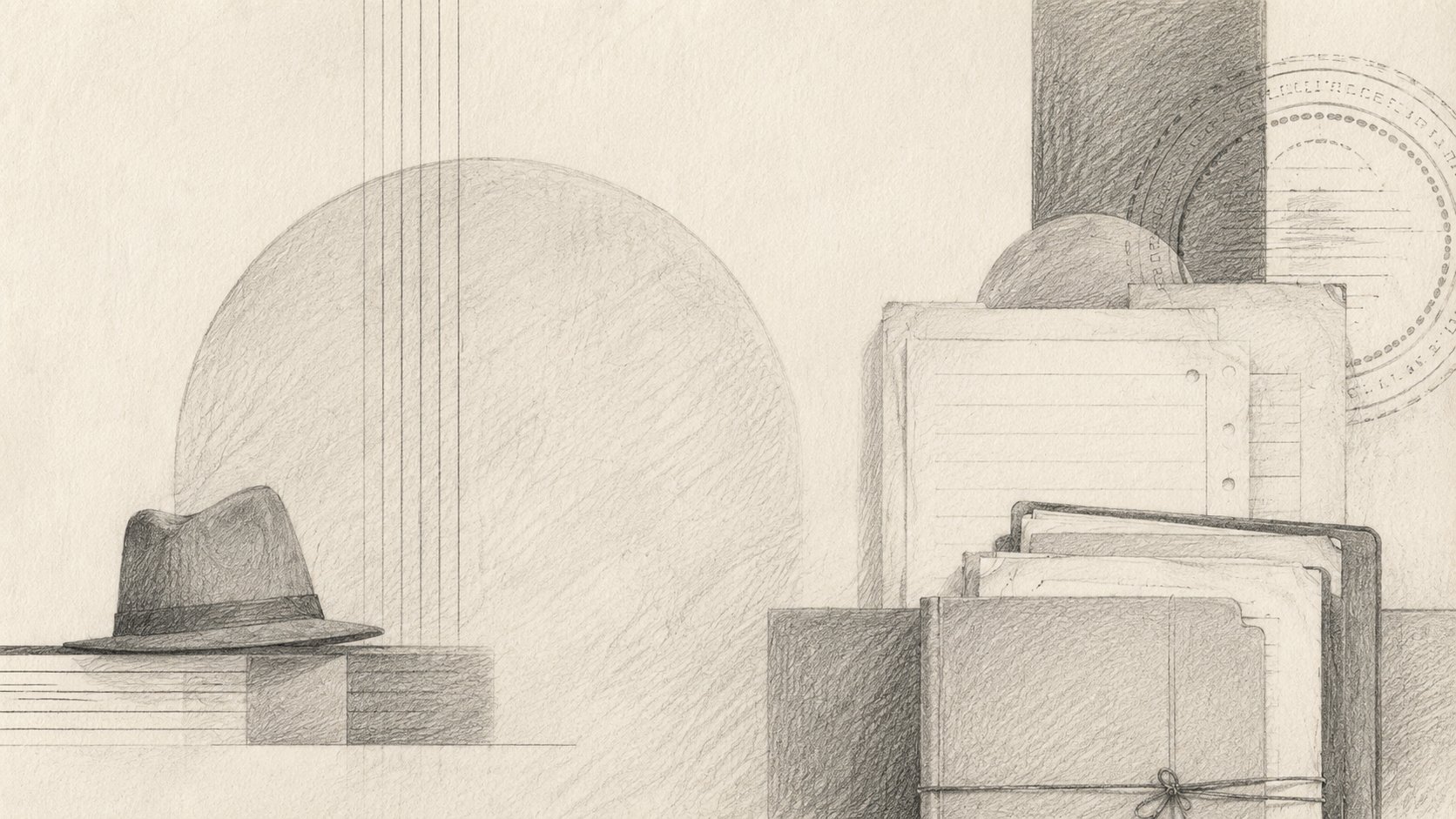
Cream paper, steel gray, dusty rose, dark green, tobacco brown, and ink black: a palette of files, uniforms, office walls, archival photographs, and the sober textile surfaces of men expected to embody a new public order.
From courtly distinction to administrative legibility
Iranian dress history is often narrated through dazzling surfaces: brocade, embroidery, court portraiture, tribal ornament, velvet robes, jeweled headgear, and regional garments. The bureaucratic suit asks for a different kind of attention. It is visually quiet, almost deliberately anti-spectacular. Yet this quietness is precisely why it mattered. In the early Pahlavi period, clothing reform belonged to a wider project of centralization, nation-building, urban modernization, and state visibility. The official male body was expected to look less local, less occupationally particular, and less regionally coded.
The shift from late Qajar multiplicity to early Pahlavi standardization was not simply a change in taste. It altered the public readability of men. A robe, turban, qaba, cloak, or regional head covering could point to locality, profession, religious status, social background, or inherited forms of authority. A suit flattened many of these distinctions. It did not eliminate hierarchy, but it relocated hierarchy into new signs: office rank, posture, photographic placement, quality of tailoring, imported fabric, polished shoes, tie discipline, and the proximity of one body to another in official images.
The history is also politically difficult and ethically charged. Dress reform was not a neutral aesthetic evolution, and its enforcement could be coercive. A responsible reading must hold two truths together: the suit participated in a modern visual language that shaped design, photography, and public identity; it also belonged to a state project that often treated clothing as an instrument of discipline. The value of studying bureaucratic menswear today lies in this tension between design intelligence and social pressure.
Period card
1925–1941 as visual turning point
The early Pahlavi period made dress part of administrative modernization. Menswear reforms, office photography, public schooling, military aesthetics, and ministry culture helped produce a more standardized image of respectable male citizenship.
Design angle
The suit as a system
Jacket, trousers, shirt, tie, hat, shoes, and grooming worked together. The important question is not whether the suit was “Western,” but how it organized the male body into a readable sign of institutional order.
Source trail
Reading photographs carefully
Official portraits, ministry groups, school images, newspapers, memoirs, and oral histories must be read as constructed evidence. Clothing in archives is never just clothing; it is also staging, selection, survival, and memory.
Dress reform and the making of public sameness
Scholarly work on Pahlavi clothing makes clear that dress reform cannot be separated from state-building. The Encyclopaedia Iranica entry on Pahlavi and post-Pahlavi clothing places the transformation of dress within broader shifts in class, urban life, and state policy. H. E. Chehabi’s influential study “Dress Codes and Nation-Building under Reza Shah” is especially useful for understanding how clothing became a political technology of national integration.
But for fashion history, the question must go further than legal reform. What did the new official look actually do on the surface of the body? It reduced visual noise. It replaced flowing, layered, and regionally varied forms with a narrow architecture of shoulder, lapel, sleeve, crease, collar, and hat brim. It made the male official easier to photograph, easier to compare, easier to place in rows, and easier to recognize as part of a larger administrative body.
The ordinary clerk, teacher, inspector, railway employee, municipal worker, and ministry officer became carriers of state image. They did not need medals or court robes to perform authority. A dark suit, a serious expression, and a disciplined posture were enough to make the body appear enrolled in the machinery of the state. This was the new drama of bureaucratic dress: not magnificence, but repeatability.
Anatomy of the official male silhouette
Shoulder line
The jacket gave the body an architectural upper frame. Even when tailoring was modest, the shoulder line suggested control, breadth, and administrative composure. It made the torso look less wrapped and more constructed.
Central axis
Shirt, tie, buttons, and jacket opening created a vertical line down the body. This axis mattered in photographs: it turned the official into a frontal, stable, readable figure.
Trouser crease
The crease extended the logic of discipline downward. It suggested maintenance, routine, and office respectability: a small textile sign of punctuality and order.
Hat discipline
Headwear was never a minor accessory. It managed the upper edge of public identity and signaled whether the wearer belonged to the new visual order of urban officialdom.
The office photograph as a fashion document
The official group photograph is one of the richest sources for this subject. It usually seems boring at first: men in rows, dark garments, plain backgrounds, sober faces. Yet its apparent dullness is an archive of design. The spacing between bodies, the repeated lapel shapes, the near-uniform darkness of jackets, the occasional pale shirtfront, the controlled hat line, and the polished shoes at the bottom edge all work as a composition.
Collections such as the Foundation for Iranian Studies Pahlavi Collection, the Smithsonian National Museum of Asian Art archive on Iran in photographs, and the Harvard Iranian Oral History Project help researchers think beyond isolated garments. They make it possible to connect clothing to institutions, memory, visual staging, and the daily procedures of public life.
In these images, the suit often operates as a background system rather than a starring object. That is why it deserves fashion-historical attention. Court dress announces itself; bureaucratic dress normalizes itself. Its ambition is to become invisible, to pass as “proper,” “serious,” or “modern.” The historian’s task is to make that invisibility visible again.
Archive wall: reading the bureaucratic image without photographs
Row formation
The group row converts individual bodies into an administrative surface. Repetition becomes evidence of institutional coherence, even when personal histories remain diverse.
Dark cloth
Black, charcoal, navy, and deep brown read as seriousness in monochrome reproduction. The suit’s chromatic restraint made it ideal for newspaper and archive circulation.
Paper background
The suit often appears beside files, desks, forms, stamps, certificates, and walls. Bureaucratic clothing belongs to a paper ecology as much as to a textile one.
Rank by placement
When garments grow similar, hierarchy moves into position: who sits, who stands, who occupies the center, and whose body receives the clearest light.
Textile, tailoring, and the politics of surface
The bureaucratic suit was not a single object. It could be locally tailored or made from imported fabric; it could fit awkwardly or elegantly; it could signal genuine professional aspiration or reluctant conformity. The material surface carried subtle distinctions. A smoother wool, better lapel roll, sharper trouser crease, or cleaner collar could separate a senior official from a provincial clerk. Even within standardization, class survived through textile quality and maintenance.
This is why “Western dress” is too blunt a phrase. The suit entered Iranian visual culture through translation, not simple replacement. Tailors interpreted patterns. Wearers adjusted posture. Photographers staged the new silhouette. Newspapers reproduced it in grainy tonal fields. Ministries made it routine. The result was not merely European clothing on Iranian bodies, but an Iranian bureaucratic image shaped by state power, urban aspiration, photography, and local practices of tailoring.
The body itself changed under the suit. Long garments often produce a continuous vertical field; the suit breaks the body into modular zones: head, collar, shoulder, torso, waist, trouser line, shoe. It is a garment of segmentation and alignment. Its beauty, if we can use that word carefully, lies in measured proportion rather than ornament. Its danger lies in the ease with which proportion becomes a sign of conformity.
Timeline ribbon: from reform to routine
Late Qajar inheritance
Administrative dress already showed signs of reform before the Pahlavi period, but visual codes remained mixed, layered, and tied to older hierarchies.
State centralization
Reza Shah’s government connected clothing to national discipline, civic appearance, and institutional modernization, especially for men in public roles.
Photographic repetition
As schools, ministries, and offices produced more images, the suited official became familiar, reproducible, and publicly legible.
Afterlife in archives
Today, these images are valued not for glamour but for evidence: they preserve the everyday visual machinery of modern Iranian state formation.
Authority without ornament
Many cultures express authority through ornament: embroidery, gold thread, jewels, symbolic color, ceremonial weapons, sashes, seals, or luxurious cloth. The bureaucratic suit expresses authority by suppressing ornament. This suppression is not absence; it is a design choice. It replaces decorative individuality with a language of restraint. The wearer appears serious because he appears controlled; he appears modern because his clothing seems rationalized; he appears official because his body matches other official bodies.
The Cambridge chapter on male dress reforms under Reza Shah is valuable because it places masculinity at the center of this transformation. Official menswear did not merely change fabric and cut; it changed the public performance of manhood. The respectable male citizen was imagined as punctual, disciplined, clean, and productive. The suit helped make these qualities visible before they were proven.
Yet this same visual discipline could also erase difference. The state’s desired image was not the same as social reality. Provincial lives, ethnic identities, religious authority, class inequalities, and private discomfort did not disappear because an official photograph made men look aligned. Bureaucratic dress should therefore be read as aspiration and pressure at once.
Color palette of administrative modernity
For this subject, the visual atmosphere should not be royal, festive, or textile-rich in a decorative sense. It should feel like an archive drawer opened inside a ministry building: cream paper, oxidized steel, muted rose from aged photographs, dark green from institutional interiors, and brown-black ink. These colors allow the article to evoke bureaucracy without becoming cold or lifeless.
Why this matters for designers, curators, collectors, and readers today
For contemporary fashion designers, early Pahlavi bureaucratic menswear offers a lesson in how restraint can carry historical force. Heritage design does not always need embroidery, motif quotation, or obvious Persian ornament. It can also work through proportion, disciplined palettes, archival tailoring, and the tension between individuality and uniformity.
For textile artists, the subject opens questions of surface and silence. What does a dark wool field communicate when ornament is removed? How does a crease become a sign? How does repetition across bodies create a visual pattern as powerful as embroidery? For curators and museum professionals, such clothing encourages exhibitions that place ordinary garments, photographs, documents, and office objects in dialogue. The British Museum’s Pahlavi dynasty collection term is a reminder that periodization itself shapes how objects are catalogued and interpreted.
For collectors and art-market observers, bureaucratic dress matters because the market increasingly values historical photographs, documents, uniforms, and ephemera that reveal everyday modernity. A glamorous court portrait may attract immediate attention, but a well-preserved ministry photograph can be more intellectually rare: it shows how a state wished to be seen at the level of routine.
For brand designers and cultural entrepreneurs, the subject offers a mature visual language: authority without shouting, heritage without nostalgia, Iranian modernity without cliché. For general readers, it explains why clothing in a family photograph, a school certificate, or an old office portrait may carry the memory of a national transformation. The suit is not only a garment; it is a small architectural plan for the public self.
Curator’s note: how to read one official body
Start with fit
A jacket that pulls, a sleeve that sits too long, or a collar that rises awkwardly may reveal the speed of adoption, the limits of tailoring access, or the wearer’s discomfort with a new visual code.
Read the hands
Hands on knees, hands behind the back, hands gripping documents, or hands hidden in pockets can change the authority of the suit. Gesture completes the garment.
Notice the edge
Hat brim, collar edge, lapel line, trouser hem, and shoe shine form the perimeter of respectability. Bureaucratic modernity often lives at the edges of cloth.
A source-informed but image-sensitive method
A serious article on this subject should avoid two easy mistakes. The first is to treat the suit as proof of successful modernization. Clothing can stage modernization before social institutions fully embody it. The second is to treat the suit only as coercion. That misses how people adapt, desire, negotiate, and personalize new forms. Some men may have worn the suit as obligation; others as ambition; many as both.
The best method is layered. Legal history explains why dress changed. Photographs show how it appeared. Tailoring analysis reveals how the body was shaped. Oral history helps recover memory, discomfort, pride, and contradiction. Newspaper culture shows how the official look circulated. Museum and archive catalogues reveal what survived and what was ignored.
This layered method keeps the garment at the center without reducing it to fabric alone. Bureaucratic menswear was a designed interface between body and state. It touched skin, structured posture, entered photographic archives, and helped ordinary men perform a new grammar of public seriousness.
Conclusion: the quiet authority of repeated cloth
The early Pahlavi suited official is not visually spectacular in the way a court robe, embroidered regional garment, or ceremonial uniform can be spectacular. Its importance lies elsewhere. It shows how modern authority learned to dress quietly. It shows how a state could enter public life not only through monuments and decrees, but through the jacket sleeve, the collar, the hat, the office photograph, and the repeated dark surface of men arranged in rows.
To study these garments is to study the aesthetics of administration. The bureaucratic suit gave the state a civilian body: serious, controlled, masculine, reproducible, and apparently ordinary. Its ordinariness was the source of its power. Once the official look became familiar, it no longer appeared designed. Fashion history must restore that design to view.
Editorial takeaway
The bureaucratic suit should be read as one of the most consequential garments of Iranian modernity: not because it was beautiful in a conventional sense, but because it trained the eye to recognize authority through restraint, repetition, proportion, and the disciplined presentation of the ordinary male body.
Correspondence, collaboration, and cultural programs
For correspondence, discussion, collaboration, questions, event updates, cultural programs, and fashion-history conversations, readers are warmly invited to reach Heritage by Sanaz through the official contact page.
Direct WhatsApp message
For a direct, calm, and personal exchange about Iranian dress history, textile culture, visual heritage, exhibitions, or future editorial collaborations, you may also send a WhatsApp message to +351914016396.