Cart 0

Research Essay
Before the rupture of 1979, Iranian women’s magazines were not merely containers of advice, celebrity news, recipes, beauty columns, or dress patterns. They were laboratories of visual persuasion. Their pages joined fashion illustration, photography, Persian typography, commercial advertising, domestic modernity, cinema culture, and shifting ideas of femininity into a highly compressed graphic language. To study these magazines as dress history is therefore to read clothing twice: first as garment, textile, silhouette, and surface; and second as printed image, layout, caption, cover, advertisement, and typographic rhythm.
The central argument of this essay is that late Pahlavi women’s magazines helped translate dress into a reproducible visual identity. The image of the dressed woman circulated through covers, illustrated columns, beauty pages, sewing features, cosmetics advertisements, film publicity, and domestic design spreads. This circulation did not simply reflect social change; it participated in shaping how modern womanhood could be seen, desired, criticized, imitated, or refused. The best scholarship on Iranian women’s print culture, especially Liora Hendelman-Baavur’s study of Iranian women’s magazines and popular culture, shows why these publications must be treated as complex cultural sites rather than simple propaganda sheets or passive copies of Western fashion media.
The approach taken here is necessarily interdisciplinary. It draws from fashion history, textile studies, visual culture, graphic-design history, Iranian media history, and museum-source reading. It treats the magazine page as a material artifact: a surface where bodies, clothing, type, ornament, paper, color, advertising, and ideology meet. Within the limits of accessible documentation, the evidence should be read as a visual and material tendency rather than a fixed universal code for all Iranian women before 1979.
Research question and thesis
The primary research question is this: how did Iranian women’s magazines before the revolution use illustration, cover design, typography, photography, and page composition to make fashion visually legible as modern identity? Several secondary questions follow. What kinds of bodies were framed as fashionable? How did hair, makeup, dress length, textile surface, accessories, pose, and facial expression become signs of class, taste, aspiration, and social mobility? How did Persian typography coexist with imported visual conventions? How did the domestic interior, the cinema star, the beauty queen, the consumer product, and the sewing pattern become part of the same visual field?
Working thesis
Magazine fashion imagery in late Pahlavi Iran transformed dress into a public grammar of aspiration. The covers and pages did not merely show clothes; they taught readers how to read modernity through clothing, posture, consumption, domestic space, and visual self-presentation.
Research caution
Surviving covers and digitized issues overrepresent urban, commercial, celebrity, and middle-class visual worlds. They illuminate a powerful media imaginary, not the complete reality of women’s clothing across region, class, religion, age, and occupation.
Design angle
The magazine page is read as designed evidence: typography, image scale, color contrast, cover hierarchy, illustration style, photographic cropping, and advertising adjacency matter as much as the garment itself.
Historical and cultural context: late Pahlavi print modernity
The most relevant historical field is the late Pahlavi period, especially the years between the mid-1950s and 1979, with particular attention to the expansion of commercial women’s magazines after the foundation of Ettelaat-e Banovan in 1957 and Zan-e Rooz in 1965. This was a period of rapid urbanization, state-directed modernization, mass media expansion, new consumer goods, changing education patterns, and intensifying debates over gender and public appearance. Gholam Khiabany’s Iranian media history is useful here because it treats the press not as a neutral channel but as a field shaped by state power, commerce, public aspiration, and contested modernity.
Yet the story did not begin in the 1960s. Iranian women’s periodical culture had earlier roots in Constitutional-era and early twentieth-century publications. Encyclopaedia Iranica’s entry on Zaban-e Zanan emphasizes the importance of women writing for women in the early Iranian press, while its entries on Alam-e Nesvan and Nama-ye Banovan place women’s periodicals within longer debates over education, reform, visibility, and public language. By the time glossy women’s magazines emerged as commercial cultural objects, they inherited a much older question: how should women appear in public print?
The visual transformation of this question depended on printing and design infrastructure. Encyclopaedia Iranica’s survey of graphic arts in the Qajar and Pahlavi periods notes the importance of lithography, typography, poster design, publishing, and institutions of art education in the development of modern Iranian graphic culture. Its companion account of lithography and typographic printing helps explain why Iranian modern design cannot be separated from the older authority of calligraphic culture, manuscript formats, and printed reproduction. Women’s magazines stood at the end of this long technological and aesthetic chain: their modernity was not only social; it was also typographic and mechanical.
The late Pahlavi page must therefore be read as a hybrid surface. It borrowed from European and American fashion publishing, cinema publicity, advertising photography, and mid-century editorial layout; at the same time, it worked within the Persian script, Iranian celebrity culture, local consumer markets, and long-standing debates over veiling, unveiling, taste, class, and respectability. Morad Moazami’s Oxford thesis on style, ideology, and popular culture in Iran from 1965 to 1979 is especially relevant for understanding why fashion imagery from this period should be studied as a political and aesthetic field at once.

The source landscape: what survives, and what remains difficult
The evidence for this field is rich but uneven. Surviving garments, textile fragments, commercial photographs, magazine covers, interior pages, paper patterns, advertisements, memoirs, film stills, beauty columns, interviews, museum objects, and press histories all contribute something different. A dress preserved in a museum gives information about cut, fiber, weight, seam, lining, finish, and alteration. A magazine cover gives information about framing, desire, display, print hierarchy, and the imagined reader. A cosmetics advertisement shows product language and facial norms. A sewing column may reveal what kinds of garments readers were expected to make, copy, or adapt.
This is why visual evidence must be handled carefully. A cover photograph is not a census of Iranian dress. It is a designed proposition. The available visual evidence suggests what editors, photographers, illustrators, advertisers, and publishers wanted to place before a reader; it does not prove what all women wore. The same caution applies to museum dress collections. Encyclopaedia Iranica’s account of clothing in the Pahlavi and post-Pahlavi periods makes clear that Iranian dress must be read across region, class, profession, public visibility, and state policy. The material record helps us see patterns, but it does not authorize a single universal code.
The best reading strategy is comparative. A cover from Zan-e Rooz can be set beside Ettelaat-e Banovan cover records on Wikimedia Commons, the institutional history of Ettelaat in Encyclopaedia Iranica, and scholarly studies such as Maryam Golabi’s article on modern domestic space in Iranian printed media. Only then can one see how fashion, home, celebrity, consumption, and visual pedagogy formed a connected printed world.

Material and garment analysis: dress as printed form
Fashion magazines make garments look lighter, cleaner, more legible, and more mobile than they may be in daily life. The page suppresses weight. It flattens texture. It turns movement into pose. Yet it also records crucial design information: neckline, sleeve length, skirt line, coat shape, textile print, contrast between matte and reflective surfaces, hair volume, eye makeup, hand placement, shoe visibility, and accessory scale. In pre-1979 Iranian women’s magazines, these details help us understand how clothing was made graphically intelligible.
The garment on a cover rarely appears alone. It appears with face, hair, type, headline, background, and often a logic of aspiration. A dress may be read through its relation to cinema glamour, beauty competition, domestic refinement, modern leisure, or consumer possibility. This is where fashion illustration and graphic design overlap. Illustration simplifies the body into line and proportion; graphic design places that body in hierarchy; photography lends immediacy and social credibility; typography instructs the reader how to interpret the image.
The clothing itself must also be placed in longer Iranian textile histories. Museum resources such as the Metropolitan Museum of Art’s essay on Safavid silk textiles, the Smithsonian’s object note on a Qajar termeh cloth, and the Victoria and Albert Museum’s publication on nineteenth-century Iranian textiles remind us that Iranian fashion modernity did not emerge from a visual vacuum. Even when magazine fashion leaned toward Euro-American silhouettes, the Iranian reader saw these images through a culture already rich in textile memory: brocade, shawl, embroidery, velvet, printed cotton, urban tailoring, regional dress, and the symbolic charge of surface ornament.
The visual record also includes absence. Many cover images suppress the labor of cutting, stitching, laundering, mending, fitting, and buying. They do not reveal whether a garment was imported, locally tailored, copied from a pattern, made at home, or adapted from a photograph. For textile historians and designers, this absence is important. It warns against treating the magazine page as proof of material availability. The page may show a desired silhouette before that silhouette was broadly accessible, or it may normalize a garment already present in urban wardrobes. The available evidence suggests a circulation of forms, not a simple chain of cause and effect.

Visual-culture analysis: the magazine body, the public gaze, and the typographic frame
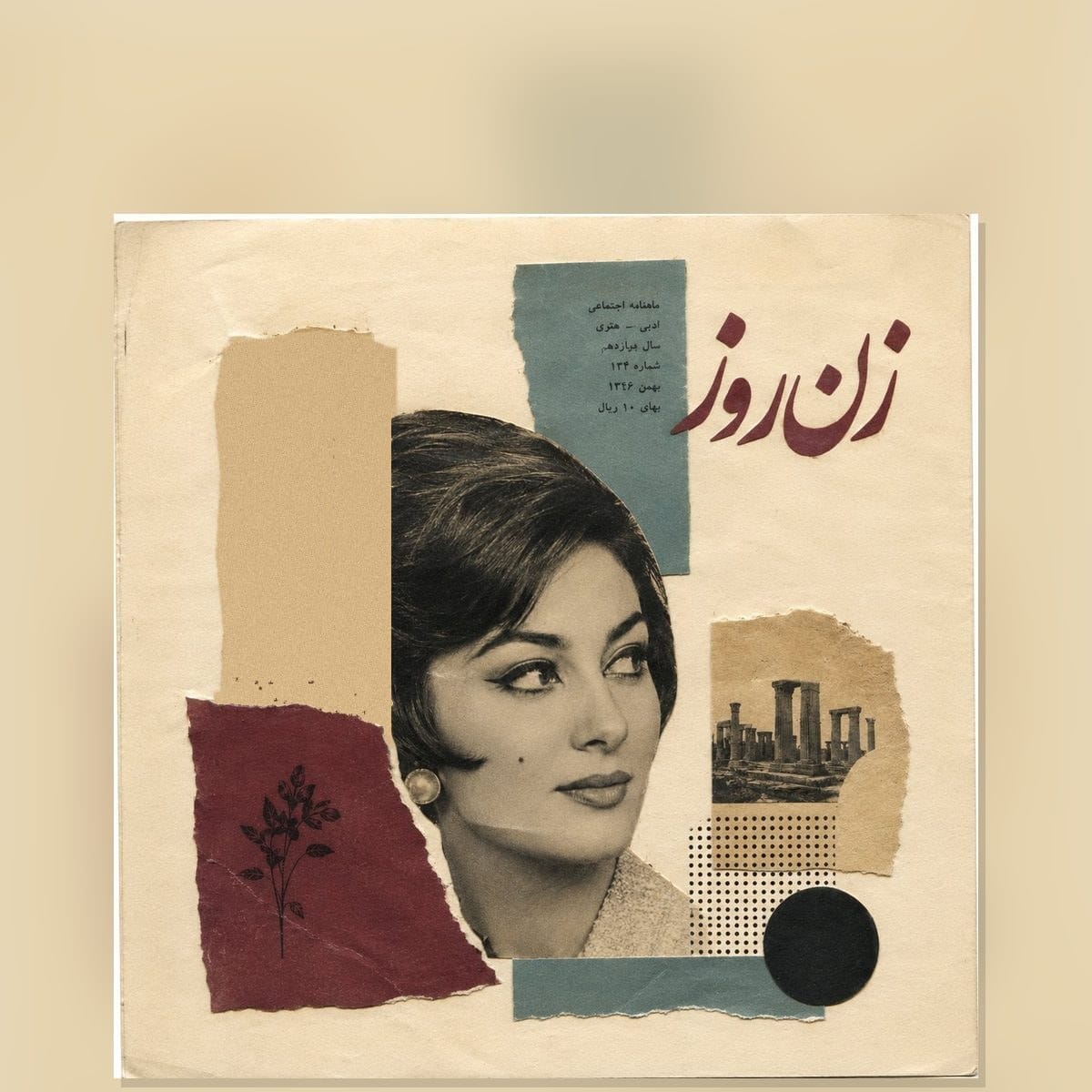
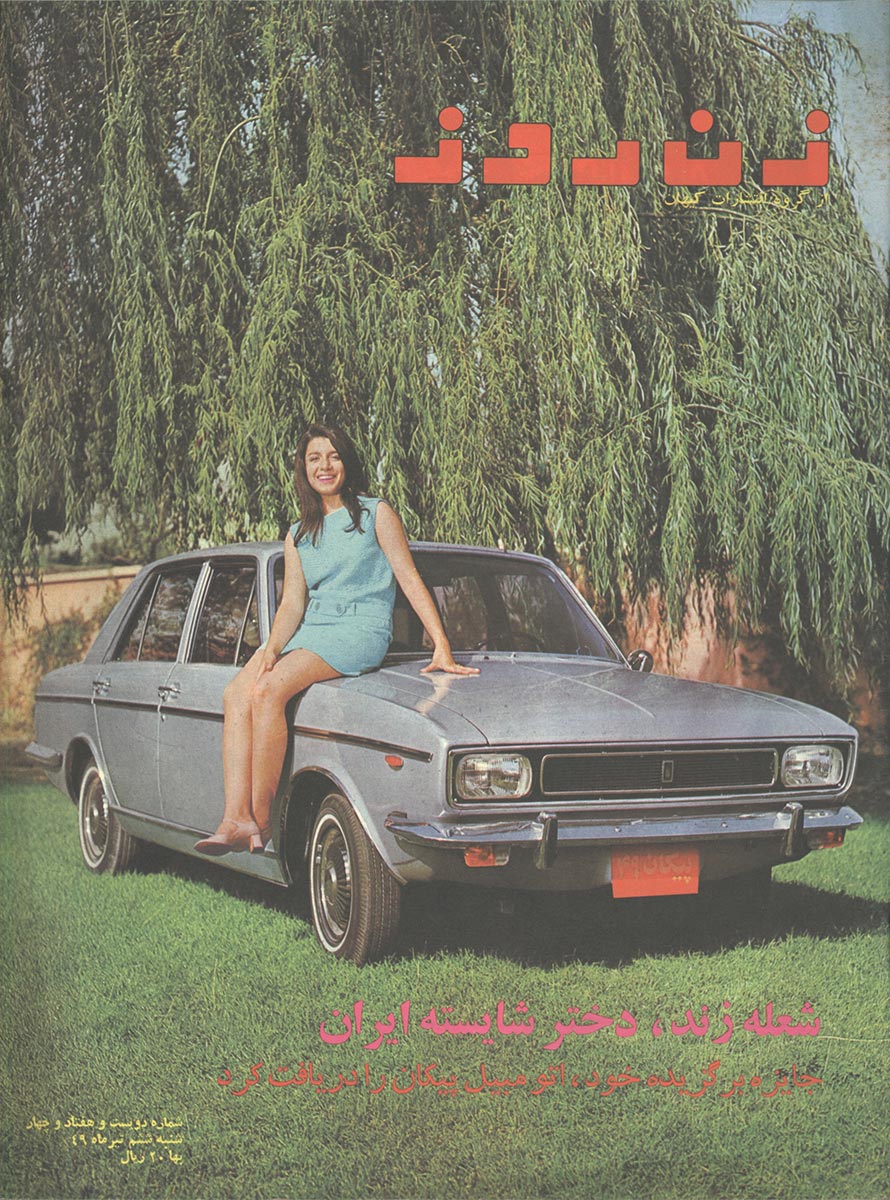
The pre-revolution women’s magazine cover frequently presents the body as a designed argument. The woman is cropped, lit, centered, angled, or framed so that the reader encounters not a person in ordinary space but a visible proposition about femininity. The cover subject may be a film actress, singer, beauty figure, model, or unnamed fashionable woman. Her clothing and face function together. Hair can signal youth, cosmopolitan taste, or celebrity glamour. Eye makeup can intensify the photographic gaze. Jewelry and accessories can mark refinement. Background color or blankness can detach the figure from everyday locality, producing a portable modern image.
Typography is essential to this construction. Persian script does not merely label the image; it shares the visual field with the body. The masthead, headline, caption, issue date, and smaller teasers create a second layer of gesture. In some covers, the text frames the body; in others it competes with it. This matters for Iranian graphic-design history because Persian typography had to negotiate between calligraphic memory and modern printed efficiency. The magazine page made that negotiation visible at mass scale.
The relationship between public and private visibility is equally important. Women’s magazines brought fashion, beauty, and domestic culture into a semi-public reading space. Golabi’s study of visual representations of modern domestic space in Iranian printed media is useful because it shows that images of modern womanhood and images of modern interiors were often linked. The fashionable woman did not appear only in the street or on the stage; she also appeared in relation to furniture, hygiene, order, color, appliances, and the visible management of the home. In this sense, dress was part of a larger design ideology: the body, the room, the product, and the printed page were all asked to look modern.
The cover should also be read beside other Iranian visual forms. The Metropolitan Museum’s essay on nineteenth-century Iran and the advent of modernity and the Smithsonian exhibition The Prince and the Shah show how photography, portraiture, and royal visuality were already transforming Iranian representation before mass women’s magazines. The magazine cover belongs to a later commercial environment, but it inherits a broader Iranian history of staged bodies, social rank, image circulation, and visual authority.
Illustration, advertising, and the designed promise of modern life
Fashion illustration in women’s magazines before 1979 should not be imagined only as drawings of dresses. It also included illustrated advertisements, beauty diagrams, hair and makeup instruction, pattern-like garment sketches, domestic design visuals, and graphic devices that translated lifestyle into line. The distinction between fashion illustration and graphic design was often porous. A drawn dress could function as instruction, fantasy, or advertisement. A photograph could be retouched, cropped, captioned, and placed so forcefully that it behaved like illustration. A product advertisement could teach the viewer how a modern body should smell, move, sit, cook, host, or appear.
This is where consumer culture becomes part of dress history. Fashion pages did not simply show garments; they arranged a world around garments. Perfume, shampoo, cosmetics, wallpaper, appliances, cars, textiles, shoes, jewelry, sewing machines, and cinema images all contributed to a design ecology in which fashionability was distributed across objects. The magazine reader encountered the clothed body beside the furnished room, the product logo, the modern appliance, the printed headline, and the promise of improved life. Rather than proving that all readers lived this way, the material record helps us see how aspiration was visually organized.
Institutional histories of Iranian design help explain this ecology. The University of Chicago’s online exhibition on Iranian poster arts during revolution and war focuses on a later political field, but it is valuable for showing how graphic surfaces became powerful tools of mobilization and public communication. If post-1979 posters demonstrate the political force of graphic design, pre-1979 women’s magazines demonstrate another kind of force: the slow, repetitive, commercial shaping of taste, gendered appearance, and visual selfhood.
The available evidence therefore asks us to read the magazine as an artifact of both desire and discipline. It offered pleasure: glamour, beauty, color, novelty, celebrity. It also offered instruction: how to dress, how to look, how to decorate, how to consume, how to become visually legible as modern. This double function is precisely why the topic matters for Iranian fashion history. The magazine did not merely report style; it trained the eye.

Museum, collecting, and archival relevance
For museums and archives, pre-1979 women’s magazines are not minor ephemera. They are evidence of design culture, gendered reading culture, commercial print, fashion circulation, and visual self-fashioning. A single cover can support research into typography, photography, consumer culture, celebrity, paper quality, printing technology, and clothing. A full issue can show the adjacency between editorial article, dress image, advertisement, and domestic advice. That adjacency is often lost when images circulate online as isolated “vintage Iran” nostalgia.
The collecting value of these magazines is partly historical and partly design-based. Complete runs, clean copies, early issues, issues with significant cover subjects, illustrated fashion pages, sewing patterns, and advertisements for cosmetics or textiles may hold particular importance for researchers. Yet their value should not be reduced to market scarcity. Their deeper importance lies in reconstructing the visual environment through which many readers encountered style. For a curator, a magazine cover can sit beside a garment, a film poster, a cosmetics package, a textile sample, or a domestic appliance catalogue to show how fashion was mediated across objects.
Museum sources also help correct the flatness of the printed image. The British Museum’s record for Persian costume imagery, the Smithsonian’s textile notes, and the Metropolitan Museum’s essays on Iranian art remind us that dress and image have long interacted in Iran. The magazine page is not the first Iranian medium to frame the body; it is a modern mass medium that reorganized older relationships between surface, status, ornament, and visibility.
Digitization has made this field more accessible, but it has also created problems. Cropped covers without issue data, unattributed scans, color-altered images, and social-media reposts can detach evidence from context. Serious research should privilege source pages, archive records, scan metadata, issue numbers, dates, and licensing notes. The Wikimedia Commons category for Zan-e Rooz covers is useful precisely because many files retain issue information, dates, file size, license status, and source notes. These details transform a nostalgic image into usable research material.
Contemporary design and market relevance
The contemporary relevance of this material is substantial, but it must be approached ethically. For fashion designers, pre-1979 magazine imagery offers lessons in silhouette, styling, editorial mood, and the translation of dress into visual identity. For textile artists, the pages reveal how surface, print, pattern, and ornament move between fabric and paper. For graphic designers, they offer a case study in Persian typography under the pressure of commercial modernity. For curators and museum professionals, they provide connective tissue between garments, advertisements, domestic objects, cinema, and public debates about women’s visibility. For collectors and art-market observers, they demonstrate why printed ephemera can hold cultural value beyond decoration.
The danger is superficial revival. A designer who extracts only a hairstyle, cover pose, or “retro Iran” mood risks flattening a complex history into nostalgia. Ethical heritage use requires attention to source, date, political context, gendered visibility, class limitation, and the difference between admiration and appropriation. The goal is not to copy magazine imagery but to understand its design intelligence: how it balanced aspiration and instruction, local script and imported visual codes, garment and printed surface, readerly intimacy and public spectacle.
This is also why the subject belongs on a serious fashion-history platform. It connects clothing heritage to graphic culture. It shows that Iranian fashion history lives not only in garments preserved in wardrobes and museums, but also in magazines, covers, commercial layouts, and illustrated promises of modern life. In a contemporary market where heritage fashion, archival design, and cultural identity are increasingly valuable, such sources offer depth, not merely aesthetic material.
Conclusion: fashion history on paper
The study of fashion illustration and magazine graphic design in Iran before 1979 reveals an essential point: dress history does not reside only in textiles and garments. It also survives in the printed systems that made clothing visible, desirable, teachable, and socially legible. Women’s magazines transformed clothing into a visual grammar by combining bodies, garments, typography, photography, illustration, advertising, and domestic aspiration. They taught readers to see style as a sign of modern life, while also exposing the tensions and exclusions built into that vision.
Within the limits of accessible documentation, these magazines should be read neither as transparent mirrors nor as trivial commercial objects. They were cultural instruments. Their covers condensed social ambition into image; their layouts placed fashion beside products, interiors, celebrities, and advice; their typography localized global editorial conventions within Persian visual language. They provide evidence of how Iranian modernity was designed on the page before it was remembered in photographs, contested in politics, or collected as nostalgia.
For scholars, they open a field of research. For designers, they offer a disciplined archive of visual strategies. For curators, they connect dress, print, gender, and consumer culture. For general readers, they reveal why a magazine cover can be more than a beautiful old image: it can be a record of how a society imagined the dressed body, the modern home, the visible woman, and the persuasive power of design.
Editorial takeaway
Pre-1979 Iranian women’s magazines should be studied as designed archives of dress culture. Their importance lies not only in the clothes they show, but in the way they arrange clothing within image, typography, gender, commerce, aspiration, and cultural memory. To read them carefully is to recover a major chapter of Iranian visual identity.
Research notes and sources
This essay has relied on a source constellation rather than a single archive. Key scholarly anchors include Hendelman-Baavur’s Cambridge study of Iranian women’s magazines, Khiabany’s media-history account of modernity and the Iranian press, Golabi’s article on printed media and modern domestic space, and Moazami’s Oxford research on style and popular culture from 1965 to 1979.
For historical and institutional context, the most useful reference points include Encyclopaedia Iranica on Iranian graphic arts, Iranica on lithography, Iranica on Ettelaat, Iranica on Pahlavi-period clothing, and Iranica on the chador as a garment. For broader visual and material comparison, museum sources from the Metropolitan Museum of Art, the Smithsonian National Museum of Asian Art, the British Museum, and the Victoria and Albert Museum help situate printed fashion within longer histories of Iranian image and textile culture.
Correspondence, collaboration, and cultural programs
For correspondence, discussion, collaboration, questions, event updates, cultural programs, and fashion-history conversations, readers are welcome to contact Heritage by Sanaz.
Direct WhatsApp message
For a direct message about cultural programs, fashion-history conversations, correspondence, or collaboration, you may also use WhatsApp: +351914016396.