Cart 0

Dress History • Textile Intelligence • Iranian Visual Culture
A garment read through stitch, surface, desert light, and social memory
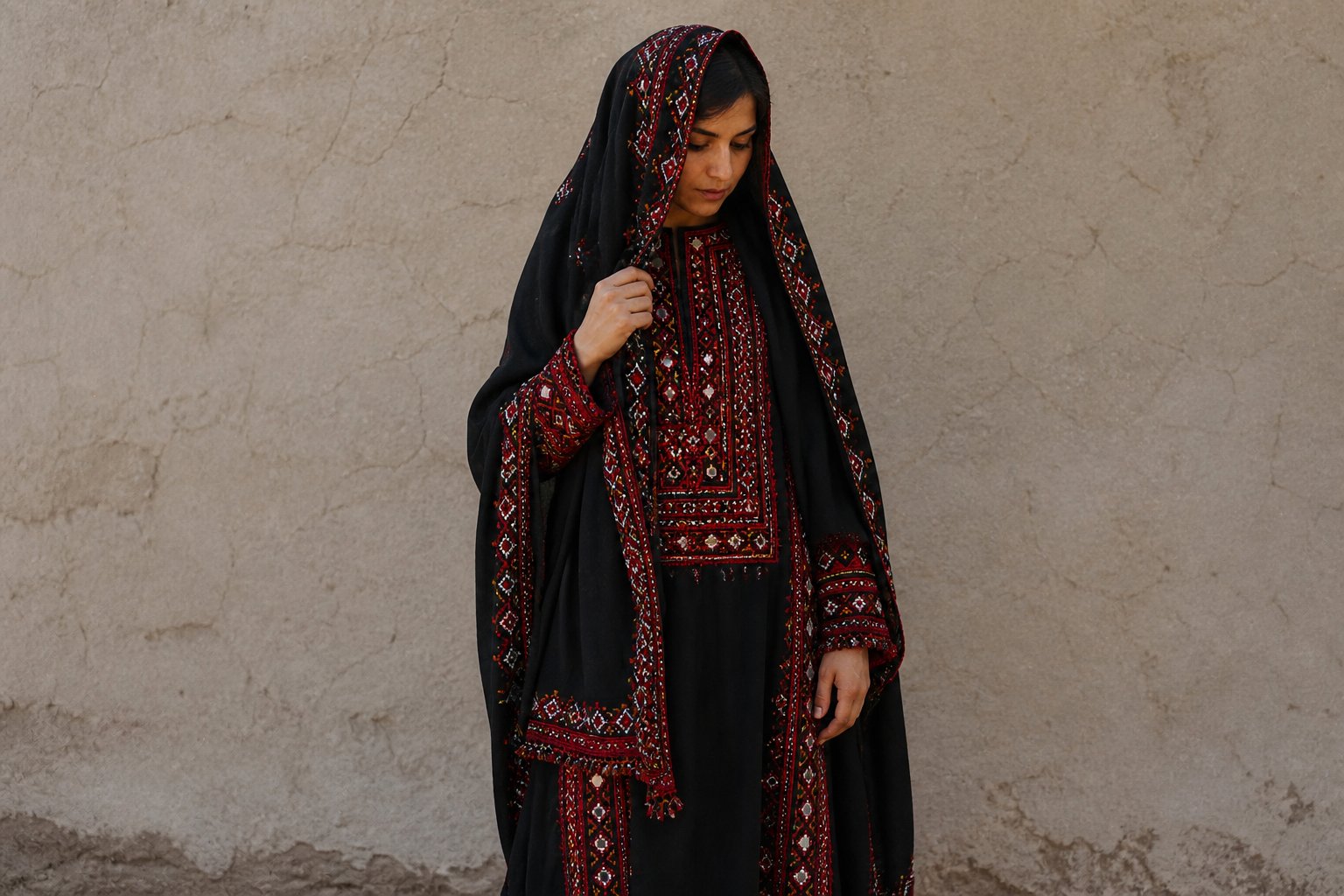
The Baluchi women’s dress of southeastern Iran is one of the most visually forceful textile systems in the Iranian cultural sphere. Its power does not come from excessive luxury, courtly display, or fragile ornament. It comes from structure: a dark ground disciplined by red and orange embroidery, a front panel that turns the body into a geometric field, sleeves and trouser cuffs that repeat the language of the chest, and a surface whose labor is legible even before its meanings are explained.
Visual atmosphere inferred for this subject:
black textile ground, crimson intensity, orange heat, silver mirror flashes, desert beige, compact geometry, patient handwork, and a rhythm closer to stitching than to spectacle.
Why this dress matters before we name its details
Baluchi women’s clothing in Iran belongs to a borderland culture whose visual forms cannot be reduced to a single national, tribal, or decorative category. Baluchistan has long connected the Iranian plateau with South Asia, Afghanistan, the Arabian Sea, and the Gulf. Encyclopaedia Iranica describes the region as a historical bridge between India, Iran, and the Arabian peninsula, a point that is essential for understanding why Baluchi dress carries both local specificity and transregional memory through cloth, cut, and embroidery. A useful starting point is the Encyclopaedia Iranica overview of Baluchistan, because it frames the region not as a cultural margin but as a zone of contact.
The dress is also a designed answer to mobility, modesty, climate, kinship, and identity. It is loose without being visually vague. It covers the body while emphasizing a carefully organized front. It is practical yet spectacular. It can be worn in daily life, preserved as a special garment, adapted for ceremony, or reinterpreted by contemporary designers. Its embroidery is not a detachable embellishment added after the form has already spoken; it is the garment’s grammar. The panel, pocket, sleeve cuff, trouser hem, and scarf create an integrated system of bodily framing.
For readers of Iranian dress history, this makes Baluchi clothing especially important. It challenges the familiar hierarchy in which court dress, urban fashion, and elite portraiture dominate the archive. Here, design intelligence is not dependent on royal patronage. It is carried by women’s hands, household transmission, regional vocabulary, and a visual discipline sustained across generations.
A palette built from ground, flame, and reflection
Black ground
Depth, contrast, visual authority.
Crimson
Heat, continuity, ceremonial force.
Orange
Desert light, stitch energy, movement.
Mirror silver
Small flashes, surface interruption, light.
Desert beige
Landscape, dryness, archival calm.
The palette is not merely decorative. The black or dark ground allows saturated embroidery to appear architectonic. Red and orange do not behave as scattered color; they hold the front of the body together. White, green, blue, and metallic touches can appear as accents, but the dominant impression is a controlled intensity: a surface that glows without losing discipline.
Historical context: southeastern Iran as a textile frontier
The relevant historical frame is not a single court period such as Safavid, Qajar, or Pahlavi, although each period matters for the wider textile history of Iran. Baluchi women’s dress should be read as a long-lived regional system that continued through late Qajar, Pahlavi, post-revolutionary, and contemporary contexts. Its forms have been shaped by local practice, trade routes, available threads, changing fabrics, and the social authority of inherited patterns. In the Iranian case, references to Baluchi clothing often point to Sistan and Baluchestan, but the visual field is wider: Baluch communities also inhabit parts of Pakistan, Afghanistan, Oman, the Gulf, and diasporic settings.
This geographical breadth matters because it prevents the dress from being treated as a frozen rural costume. It is better understood as a living textile language with regional variants. A bodice panel may carry one vocabulary, a pocket another, a sleeve cuff another. A dress made for everyday use may differ from one made for marriage, festival, or display. Yet the underlying design logic remains recognizable: a loose dress, trousers, scarf or head covering, and intense embroidery placed at specific structural points.
Iranian textile history is often narrated through luxury silk, brocade, court workshops, urban tailoring, and museum-quality fragments. The Metropolitan Museum of Art’s essay on Safavid Iranian silk textiles is useful for understanding the high-art textile tradition, but Baluchi dress asks a different question: how does a community create visual complexity without relying on courtly fabric production? Its answer is embroidery as architecture.
Garment anatomy: the body as a structured textile field
BODICE PANEL
LONG FRONT PANEL / POCKET
The front of the dress functions almost like a vertical textile manuscript: the chest, waist, and skirt are joined by a dense ornamental axis.
Reading the parts
The most recognizable features are the embroidered chest panel, the long vertical front panel that often doubles as a pocket, sleeve-cuff panels, and embroidered trouser hems. Encyclopaedia Iranica’s entry on clothing of the Baluch in Persia describes the women’s robe as straight and loose, with embroidery covering the dress front and the cuffs of sleeves and trousers. This placement is crucial: ornament appears where the body moves, bends, reaches, sits, walks, and is seen.
The dress is therefore not a flat decorative surface. It is a mobile structure. The chest panel stabilizes the upper body visually; the long front panel draws the eye downward; the sleeve and trouser cuffs turn movement into pattern. Even when the garment is modest in cut, it is not visually passive. Its surface organizes attention with remarkable precision.
Embroidery as visual grammar, not surface excess
The key mistake in reading Baluchi embroidery is to treat it as decoration applied to an otherwise simple garment. The embroidery is the system through which the dress becomes socially legible. Pattern, density, placement, thread color, and motif variation all contribute to recognition. The textile does not need a written label to communicate regional belonging, skill, care, and memory. It announces itself through its own visual syntax.
The Textile Research Centre in Leiden describes Baluch embroidery as a decorative needlework tradition associated with Baluch communities in southeastern Iran, Pakistan, Afghanistan, and related diasporic areas. Its summary of Baluch embroidery is especially helpful because it identifies the major garment parts: trousers, dress, large shawl, chest panel, sleeve cuffs, and long pocket. Such descriptions make clear that embroidery follows garment structure; it does not float randomly across cloth.
The stitch logic is also a labor history. A dense embroidered panel records time compressed into surface. It is the opposite of industrial speed. To a designer, this matters because it offers a model of slow pattern-making in which repetition does not become monotony. To a collector or curator, it matters because the object carries evidence of hand, household, transmission, and repair. To a general reader, it matters because beauty here is not abstract; it is made through attention.
Stitch logic board: how the surface is organized
Outline
Motifs begin with disciplined borders. The outline gives the panel its authority and prevents the dense color from dissolving into visual noise.
Fill
Color fills the structure with controlled heat. Red and orange operate as weight-bearing tones rather than ornamental afterthoughts.
Flash
Mirror-work or pale accents interrupt the matte textile field. They introduce light, but in small doses, preserving the seriousness of the ground.
Ground
The dark base is not emptiness. It is the field that makes density visible, giving the garment its architectural contrast.
Form and movement: loose cut, concentrated intensity
The silhouette of Baluchi women’s dress is often loose, practical, and layered. This looseness should not be mistaken for lack of design. In fashion history, tailored narrowness is too often treated as evidence of sophistication, while generous cut is treated as ethnographic costume. Baluchi clothing resists that hierarchy. Its design intelligence lies in the relation between volume and concentration. The body is given ease, but the eye is given structure.
The dress works through a productive tension: the overall garment expands around the body, while the embroidery tightens the visual field. The chest panel creates a square or rectangular focus. The long front panel extends downward and can function as a pocket. Sleeve cuffs and trouser hems complete the system by marking the moving edges of the body. The result is a garment that balances modest coverage with unmistakable visual presence.
This is why the dress remains relevant to contemporary fashion design. It offers a sophisticated alternative to the modern obsession with silhouette alone. Here, form is not only the outline of the body. Form is the placement of pattern, the behavior of color against ground, the repetition of motifs across moving joints, and the transformation of utility into beauty.
Museum evidence and the afterlife of the garment
Museum collections help make Baluchi clothing visible to global audiences, but they also create a problem. Once a garment enters a museum, it may be separated from body, use, maker, region, and everyday life. The challenge is to read the object without turning it into mute ethnographic material. The British Museum’s record for a Baluchi dress associated with Oman is valuable because it describes the three-piece garment, embroidery concentration, mirror-work, and the large front panel that also serves as a pocket. It also reveals the transregional movement of Baluchi forms across Iran, Pakistan, Oman, and the Gulf.
For Iranian dress history, this museum afterlife is crucial. A dress in a collection may no longer be worn, but it continues to produce meaning. It enters catalogues, exhibitions, conservation laboratories, academic courses, auction conversations, design mood boards, and cultural debates about appropriation and revival. The V&A’s public programming on women’s dress in modern Iran and Afghanistan shows how museums increasingly frame dress as a serious field of art-historical study rather than a secondary craft category.
The garment’s afterlife also raises ethical questions. Who is named? Who is absent? Is the maker known? Is the region described precisely? Are motifs explained by community knowledge or by outside interpretation? These questions matter because the market and museum worlds can easily value the object while erasing the womanly labor that made it possible.
Color as identity, not decoration
The most immediate visual fact of Baluchi women’s dress is color. Black or dark grounds, red and orange embroidery, occasional white, green, blue, and reflective accents create a surface that is both bold and controlled. In many examples, color does not imitate nature. It creates a social field. It marks the body as belonging to a tradition of making, wearing, recognition, and memory.
Red and orange have particular force because they operate against darkness. They do not need a large range of hues to create complexity. Complexity comes from density, stitch direction, motif variation, and the way one panel relates to another. The dress therefore teaches a valuable lesson for designers: a limited palette can produce enormous visual richness if structure is strong. In contemporary fashion language, this is brand identity before branding; a recognizable visual code formed by repeated material decisions over time.
Mirror-work adds another layer. The reflective element is small but symbolically powerful. It interrupts textile opacity and makes the surface responsive to light. In motion, these flashes prevent the garment from becoming purely graphic. The dress becomes optical, bodily, and environmental at once.
Material culture map: where value is held
In the hand
Value begins with labor: counted stitches, repeated gestures, inherited knowledge, and the ability to maintain geometric control over a dense surface.
In the panel
The embroidered sections concentrate meaning. They can outlive the base fabric, be repaired, resewn, preserved, or studied as independent design units.
In the archive
Once collected, the dress becomes evidence: of regional identity, trade, gendered labor, material adaptation, and the changing status of craft.
In contemporary design
The visual system can inspire ethical revival, but only when designers respect provenance, community knowledge, and the difference between reference and extraction.
Why the subject matters now: design, collecting, research, and market relevance
For contemporary fashion designers, Baluchi dress offers a lesson in how surface can construct identity without relying on logos or trend cycles. Its most powerful design principle is not motif borrowing but structural integration: the embroidery belongs to the anatomy of the garment. Designers interested in heritage revival should study this relationship before adapting individual patterns. The ethical question is not simply “Can this motif be used?” but “Can the design logic be understood, credited, and transformed with responsibility?”
For textile artists, the dress demonstrates how repetition, density, and restricted palette can create a field of emotional force. It is a masterclass in patience. For curators and museum professionals, it raises questions of attribution, display, conservation, and regional precision. A dress shown without context becomes a beautiful object; a dress interpreted through stitch, gendered labor, mobility, and regional history becomes a cultural document.
For collectors and art-market observers, Baluchi women’s dress sits at an increasingly important intersection: textile heritage, wearable art, craft authorship, and global interest in non-Western material culture. Market value is shaped by condition, age, density of embroidery, rarity of materials, provenance, regional specificity, and whether the object is complete with trousers and head covering. But cultural value cannot be measured by price alone. A heavily worn dress may be less market-perfect and more historically eloquent because it carries evidence of use.
For visual researchers and brand designers, Baluchi clothing offers a powerful case study in identity systems. Its palette, geometry, and placement rules create immediate recognition. This is not branding in the commercial sense, but it explains why heritage textiles can influence contemporary visual identity. Color, repetition, and surface rhythm generate memory.
For general readers, the dress matters because it expands the idea of Iranian beauty. It reminds us that Iranian visual culture is not only palace tile, miniature painting, carpet, calligraphy, or urban fashion photography. It is also the dense red stitch on black cloth, the practical pocket turned into a monumental panel, the scarf edge, the moving cuff, and the social intelligence of clothing made to be lived in.
A responsible source trail for deeper study
Serious research on Iranian dress requires moving between different kinds of sources. Encyclopaedia entries help establish terminology and historical context. Museum records help identify object types, materials, and collection histories. Textile research centers help clarify technique. Iranian collections help reconnect the subject to local textile heritage. The Manouchehri Textile Collection in Kashan, for example, is not specifically a Baluchi dress archive, but it is significant for understanding the broader value of textile preservation within Iran and the need to study clothing and decorative fabrics as cultural evidence.
The best reading method is comparative but careful: compare Baluchi embroidery with other Iranian textile traditions, but do not dissolve its specificity into a generic “Persian textile” category. Compare museum garments across Iran, Pakistan, Oman, and Afghanistan, but do not erase the distinct historical experience of each community. Compare contemporary designer uses of Baluchi motifs, but always ask whether makers, regions, and craft lineages are named.
Contemporary revival and the ethics of beauty
Baluchi embroidery has obvious appeal for contemporary fashion: strong color, graphic geometry, handmade aura, regional specificity, and immediate visual impact. These qualities can attract designers, collectors, galleries, and cultural entrepreneurs. But this appeal creates risk. Heritage can be flattened into surface; women’s labor can become anonymous; motifs can be extracted without credit; and regional identity can be turned into a mood board.
A more responsible approach begins by treating the dress as a designed system rather than a storehouse of motifs. The panel placement, the pocket function, the relation between embroidery and movement, and the visual contrast between ground and thread are as important as any individual pattern. Contemporary designers who understand this can create work that enters into dialogue with Baluchi textile intelligence rather than simply consuming it.
This also matters for cultural entrepreneurship. The future value of Baluchi textile heritage should not depend only on luxury reinterpretation. It can also be supported through documentation, fair collaboration, artisan credit, educational programming, museum partnerships, careful publishing, and market models that keep craft communities visible. Beauty becomes ethical when it preserves relation.
How to read the garment in five passes
First: silhouette
Look at looseness, length, layering, and how the dress frames movement.
Look at looseness, length, layering, and how the dress frames movement.
Second: placement
Notice where embroidery appears: chest, front panel, cuffs, and hems.
Notice where embroidery appears: chest, front panel, cuffs, and hems.
Third: density
Read the labor. Dense embroidery is time made visible.
Read the labor. Dense embroidery is time made visible.
Fourth: color
Study how red and orange behave against black or dark ground.
Study how red and orange behave against black or dark ground.
Fifth: afterlife
Ask whether the object is worn, inherited, collected, displayed, or revived.
Ask whether the object is worn, inherited, collected, displayed, or revived.
Conclusion: a living architecture of stitch and identity
Baluchi women’s dress in southeastern Iran is not important because it is “traditional” in a nostalgic sense. It is important because it shows how a community can create an enduring visual system through cloth. The dress holds multiple forms of intelligence at once: garment engineering, color discipline, regional identity, bodily modesty, craft labor, household knowledge, and market afterlife. It belongs to everyday life and to the museum. It belongs to personal identity and to art history. It belongs to the hand and to the archive.
Its most valuable lesson may be that clothing does not need to choose between beauty and utility. The long front panel can be both pocket and emblem. The loose dress can be both modest and visually commanding. The cuff can be both edge and ornament. The mirror can be both material and light. The stitch can be both labor and language.
For fashion designers, textile artists, historians, curators, collectors, and general readers, the garment offers a model of how identity can be built slowly, materially, and beautifully. It asks us to look longer. Not at costume as a frozen relic, but at dress as cultural thought made wearable.
Editorial takeaway
The most responsible way to understand Baluchi dress is to read it as a complete visual language: cut, panel, pocket, cuff, thread, color, mirror, movement, and memory. Its value today lies not only in its beauty, but in the design intelligence and cultural labor that beauty preserves.
Correspondence, collaboration, and cultural programs
For correspondence, discussion, collaboration, questions, event updates, cultural programs, and fashion-history conversations, readers are warmly invited to contact the editorial team. Heritage by Sanaz welcomes serious dialogue with artists, designers, researchers, collectors, curators, and readers interested in Iranian dress and textile heritage.
Direct WhatsApp message
For a direct message about cultural conversations, collaborations, events, or editorial inquiries, you may also reach Heritage by Sanaz through WhatsApp at +351914016396. The tone of this invitation is simple: a calm, direct channel for serious cultural exchange.