Cart 0

Contemporary Dress / Archive Intelligence
When the museum becomes a studio of memory
A museum garment is never only a survivor. It is a compressed design document: a record of cut, proportion, textile weight, bodily discipline, social aspiration, craft labor, and visual authority. For contemporary Iranian dress, museum collections can function as more than sources of admiration. They can become working archives for designers who want to think seriously about form, inheritance, and modern identity.
The strongest contemporary design does not imitate the past as costume. It studies how garments once organized the body, how fabrics carried status, how borders controlled movement, how embroidery turned labor into surface, and how clothing became socially legible. In this sense, the museum is not a cemetery of old things. It is a disciplined room where design thinking can begin again.
Archive palette
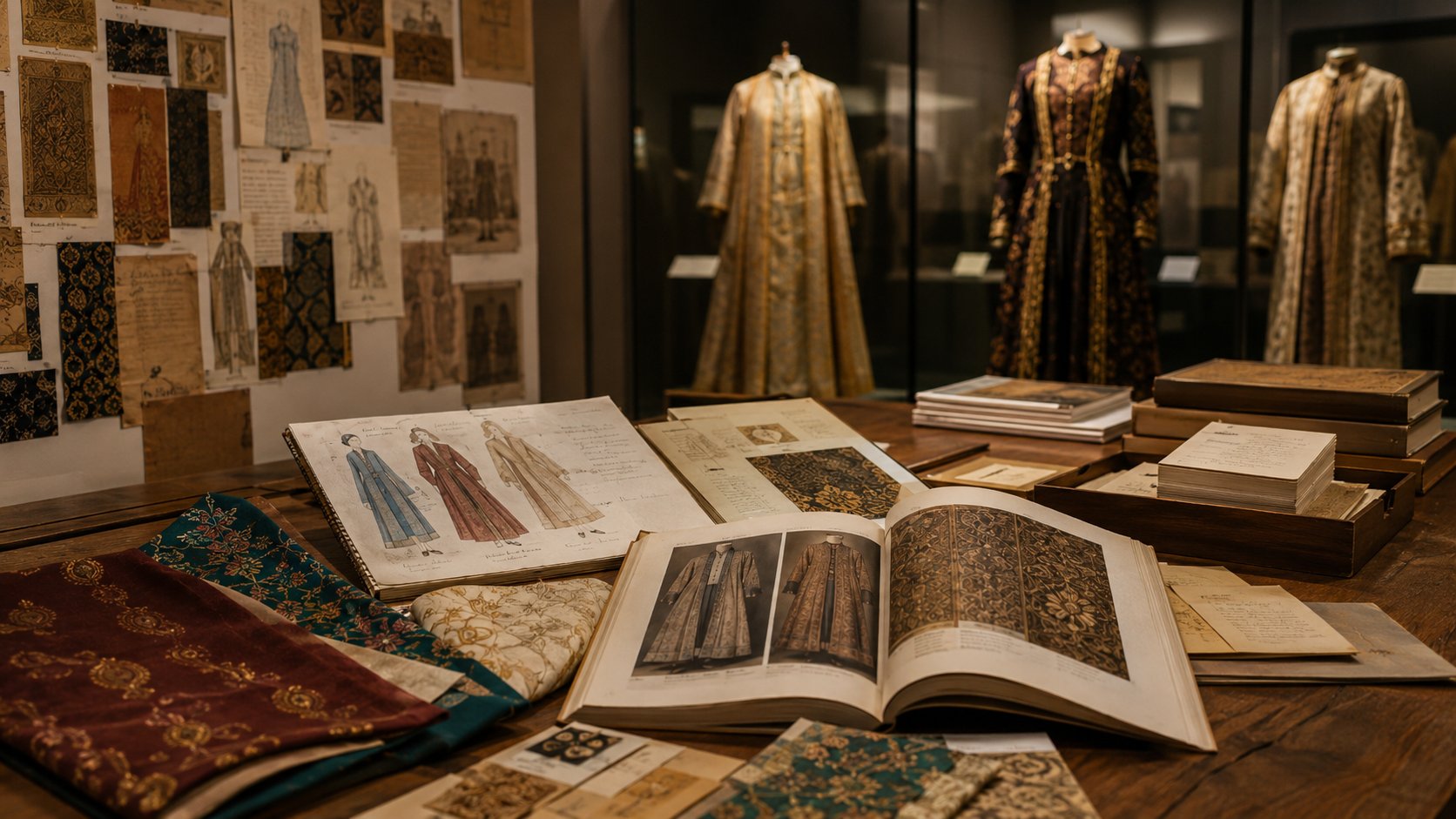
The visual atmosphere here belongs to the contemporary museum archive: clean ivory, graphite, clay, muted gold, burgundy, and the quiet shadow of conservation rooms. The palette avoids nostalgia and instead frames heritage as research material.
catalogue logic
textile memory
design revival
market value
textile memory
design revival
market value
Why preserved dress changes contemporary design
For Iranian dress history, museum collections are unusually important because clothing survives unevenly. Many garments were worn until they weakened, altered for new bodies, cut into fragments, sold through dealers, inherited privately, or preserved abroad under categories that do not always reflect Iranian naming systems. A surviving jacket, robe, veil, sash, printed cotton, woven silk, or embroidered panel may therefore carry more than aesthetic value. It may be one of the few material witnesses to an entire world of making.
This matters deeply for contemporary Iranian dress. Designers often encounter the past through images: Qajar photographs, Safavid paintings, studio portraits, family albums, book illustrations, or Instagram reproductions. Images are powerful, but they flatten garments into surface. Museum objects restore other forms of knowledge: thickness, lining, seam placement, scale, repair, reverse side, fading, metal-thread wear, fastening logic, and the difference between a garment that looks dramatic in a portrait and a garment that actually moves on a body.
A contemporary designer who studies museum-held clothing learns to ask better questions. Where does the fabric carry weight? Which part of the garment was meant to be seen first? Does ornament frame the face, the hand, the hem, or the chest? Does the silhouette enlarge the body, discipline it, conceal it, or make it ceremonial? These questions move Iranian fashion heritage away from decorative borrowing and toward design literacy.
A museum-to-studio circuit
The relationship between collections and contemporary design is not a simple movement from old object to new garment. It is a circuit of interpretation. The museum classifies and preserves; the catalogue translates objects into searchable language; the curator frames meaning; the viewer compares; the designer extracts principles; the contemporary garment tests those principles in a new social world.
01 / Object
The garment enters a collection with material evidence: fiber, cut, wear, repair, and provenance.
02 / Catalogue
The museum assigns terms that shape how later researchers search, compare, and understand it.
03 / Display
Exhibition lighting, labels, and grouping turn the garment into a public argument about heritage.
04 / Studio
The designer converts archival knowledge into proportion, textile choice, restraint, rhythm, or silhouette.
05 / Market
The new object enters cultural circulation, where heritage becomes identity, value, and responsibility.
Historical memory without costume thinking
The most productive museum research does not ask contemporary designers to reproduce historical clothing literally. Iranian dress history covers courtly robes, regional garments, urban tailoring, veiling practices, military dress, imported fabrics, ceremonial clothing, domestic textiles, and modern fashion adaptations. No single archive can represent all of this complexity. A responsible designer therefore treats museum collections as partial evidence, not as a total definition of Iranian clothing.
A broad reference point such as the Encyclopaedia Iranica clothing index reminds us that Iranian dress must be read across long historical periods, regional variation, social function, and changing vocabulary. Museum collections then add the material dimension: the actual behavior of fabric, the scale of ornament, the survival of certain objects over others, and the ways catalogues classify what was once lived practice.
This is where contemporary Iranian dress becomes intellectually interesting. The designer is not simply “inspired by heritage.” The designer is negotiating between archival survival and present use. A Safavid textile fragment may teach surface rhythm without prescribing a garment. A Qajar photograph may reveal posture and bodily presentation without offering construction details. A preserved jacket may suggest proportion, but not the social world that once gave that proportion meaning. Good design begins in this tension.
How to read a garment as an archive
A museum garment can be approached like a layered document. The front view is only the first page. The reverse, lining, seams, stains, repairs, borders, and zones of wear often speak more honestly than the most spectacular surface.
Silhouette
Silhouette records how a culture imagines bodily presence. Is the garment columnar, flared, wrapped, suspended, layered, or structured around the shoulders? Contemporary design can translate this into modern volume without copying the original form.
Surface
Surface is not ornament alone. Embroidery, metallic thread, woven motif, printed repeat, or plain fabric all regulate attention. They decide whether the eye rests on the border, center, sleeve, neckline, or moving hem.
Construction
Cut and construction reveal intelligence hidden beneath beauty. A museum object may show economical patterning, ingenious reinforcement, hand finishing, or alterations that expose the garment’s afterlife.
Use
Wear marks, fading, and repair interrupt the fantasy of untouched heritage. They remind the designer that clothing lives through bodies, gestures, weather, labor, ceremony, and repeated handling.
The museum object and the designer’s eye
Museum collections change design because they slow down looking. A contemporary fashion image is often consumed instantly, but a preserved garment resists speed. It asks the viewer to move from general impression to technical reading. A designer who studies a robe, jacket, sash, veil, textile panel, or embroidered fragment learns to separate motif from structure, surface from proportion, and historical reference from design principle.
The Metropolitan Museum of Art’s essay on fashion in Safavid Iran, for example, shows how garments and textiles can be read through color, figural motifs, luxury materials, and elite self-presentation. Its related discussion of Safavid silk textiles is equally useful for contemporary designers because it connects textile design to manuscript culture, garden imagery, figural scenes, and the movement of luxury taste.
The lesson is not that a modern garment should look Safavid. The lesson is that design systems can travel. A designer might learn from the placement of repeated figures, the relationship between narrative and fabric, the visual economy of borders, or the way metallic thread transforms light. These principles can become a jacket, scarf, installation garment, textile print, digital collection, or brand language without turning history into theatrical costume.
Archive wall: four design translations
From robe to proportion
A historical robe may suggest a contemporary coat not through ornament, but through its distribution of volume: a measured shoulder, a calm front opening, a controlled fall of fabric, and a sense of authority produced by proportion rather than excessive decoration.
From textile to rhythm
A museum textile can become a lesson in repeat, interval, and emphasis. Contemporary surface design can borrow this rhythm without reproducing the motif, allowing heritage to appear as visual grammar rather than quotation.
From repair to ethics
Visible repair, fading, and alteration can guide sustainable fashion thinking. They shift attention from novelty to continuity, from perfect surface to lived material, and from consumption to stewardship.
From catalogue to story
Catalogue language helps designers build responsible narratives. Dates, materials, regions, and collection histories prevent vague exoticism and create a more precise relationship between garment, place, and memory.
Collections are never neutral
A serious use of museum collections must also recognize that museums shape the past. They decide what is collected, what is conserved, what is photographed, what is digitized, what is displayed, and what remains in storage. A garment in a major museum may become more visible than an equally important garment held in a family trunk, a regional collection, or a private archive. Visibility can create authority, and authority can influence what contemporary designers think is historically important.
This is especially important for Iranian dress, where regional, ethnic, urban, elite, domestic, and ceremonial forms may be unevenly represented. The archive often preserves objects that traveled through collectors, dealers, diplomatic networks, excavation histories, or elite ownership. Contemporary designers should therefore read museum collections with admiration and caution. The museum can open the past, but it can also narrow it.
The best design response is comparative research. Study major institutions, but also look at local textile collections, family photographs, oral histories, craft communities, and contemporary makers. A museum object becomes more meaningful when placed beside living knowledge. Heritage design becomes stronger when archival prestige is balanced by cultural accountability.
Source trail for contemporary research
Useful museum research depends on moving between object databases, exhibition essays, catalogues, and specialist archives. The following source types are especially relevant for designers, curators, and visual researchers working with Iranian dress and textile heritage.
Exhibition essays
Curated exhibitions such as the Smithsonian National Museum of Asian Art’s Fashioning an Empire help connect textiles to portraiture, court culture, and display practice. They are valuable because they show how museums build arguments around objects, not merely inventories.
Collection-led learning
The Victoria and Albert Museum’s study program on women’s dress in modern Iran and Afghanistan is a useful reminder that garments become design education when viewers are brought close to textile objects, curatorial language, and comparative material evidence.
Regional and private archives
Resources such as Women’s Worlds in Qajar Iran and the Manouchehri Textile Collection expand the research field beyond the single museum object and help designers see dress through domestic life, photography, social history, and textile collecting.
International circulation
The Museum of Islamic Art in Doha’s presentation of Safavid textile culture shows how Iranian material heritage circulates through global exhibitions, institutional partnerships, and new audiences. This circulation affects both scholarship and market perception.
Why this matters now
The contemporary relevance of museum collections is not limited to academic research. It touches fashion design, textile practice, collecting, curation, branding, cultural entrepreneurship, and the wider public understanding of Iranian visual identity. The market for heritage-based design is growing globally, but its quality depends on depth. A garment that merely decorates itself with a Persian motif may attract attention briefly. A garment built from careful archival reading can carry more authority, more originality, and more durable cultural value.
For contemporary fashion designers, museum collections provide a disciplined alternative to mood-board orientalism. They make it possible to study proportion, restraint, fabric hierarchy, and historical construction. For textile artists, collections reveal technical systems: repeat structures, embroidery density, woven imagery, border logic, and the relationship between hand labor and visual intensity. For curators and museum professionals, contemporary design responses can activate collections for new audiences without reducing them to spectacle.
Collectors and art-market observers also have reason to pay attention. Museum visibility can influence value by educating the eye. When an institution frames a textile as historically significant, the market often becomes more attentive to comparable objects, techniques, and regions. This does not mean that museum validation should become the only measure of value. It means that research, provenance, condition, rarity, and interpretive importance increasingly shape how textile heritage is understood as collectible cultural material.
For brand designers and cultural entrepreneurs, the lesson is strategic. Heritage has market power when it is precise. A contemporary Iranian fashion brand that can explain why a sleeve proportion matters, why a border placement matters, why a certain textile weight changes movement, or why a motif should be transformed rather than copied will communicate more credibility than a brand that relies on vague nostalgia. For general readers, this approach restores dignity to clothing itself. It teaches that dress is not superficial; it is a language of body, memory, beauty, rank, labor, and belonging.
A value map for heritage-based design
Cultural value
A museum-informed garment can carry cultural memory without becoming a copy. It gives viewers a way to recognize Iranian visual heritage through structure, rhythm, and material intelligence.
Design value
Collections help designers move beyond surface quotation. They provide evidence for proportion, layering, tactile contrast, and garment behavior, which are the foundations of serious fashion design.
Market value
Well-researched heritage design can differentiate a brand, support higher perceived value, and attract collectors who care about story, rarity, craft, and cultural specificity.
Ethical value
The archive encourages designers to name sources, respect craft communities, avoid careless appropriation, and understand heritage as a responsibility rather than an aesthetic shortcut.
From preservation to contemporary authorship
The central question is not whether contemporary designers should use historical references. They already do. The real question is how they use them. Museum collections can encourage a shift from extraction to authorship. Extraction takes a motif and places it on a product. Authorship studies the system behind the motif and creates a new work with its own formal necessity.
This distinction is crucial for contemporary Iranian dress because visual heritage is highly recognizable. Persianate floral forms, calligraphic curves, boteh shapes, metallic surfaces, mirror-like embellishments, and courtly color combinations can quickly become cliché when detached from research. Museum collections help resist that flattening. They show that Iranian dress and textile culture were never merely decorative; they were systems of status, climate, technique, mobility, modesty, spectacle, and social address.
A modern designer may respond by simplifying, abstracting, reversing, enlarging, softening, or structurally translating archival material. A border may become a seam principle. A lining may inspire a hidden color story. A robe’s openness may become a contemporary jacket’s movement. A textile fragment may become a print logic rather than a repeated historical motif. This is how a collection becomes generative without being consumed.
Conclusion: the archive as a living design discipline
Museum collections do not simply preserve Iranian garments and textiles; they influence how the past becomes visible, teachable, collectible, and usable. They shape the designer’s imagination by organizing fragments of material history into objects of study. But the museum is strongest when it is treated as the beginning of inquiry, not its end.
For contemporary Iranian dress, the archive offers a demanding form of freedom. It does not ask designers to repeat old garments. It asks them to see more precisely: to understand weight, rhythm, proportion, repair, surface, and social legibility. It asks them to respect what survives and to notice what is missing. It asks them to transform heritage through knowledge rather than through decorative possession.
The most compelling future for Iranian fashion heritage will not come from choosing between museum and market, past and present, scholarship and beauty. It will come from designers, researchers, curators, collectors, and readers who understand that clothing is a designed archive of human life. When read carefully, a preserved garment can become a contemporary method.
Editorial takeaway
A museum archive becomes powerful for contemporary Iranian dress when it is approached as a design laboratory: not a storehouse of motifs to copy, but a field of evidence about how garments organize the body, carry memory, produce value, and translate culture into form.
Correspondence and cultural collaboration
For correspondence, discussion, collaboration, questions, event updates, cultural programs, and fashion-history conversations, readers are warmly invited to Contact Heritage by Sanaz. The project welcomes thoughtful exchange with artists, designers, curators, collectors, researchers, and readers interested in Iranian dress heritage.
Heritage by Sanaz
Research, dialogue, events, exhibitions, and visual culture programs.
Direct WhatsApp message
For a calm and direct conversation about fashion-history research, cultural programs, collaborations, or collection-related questions, you may also Send a direct WhatsApp message to +351914016396.
WhatsApp
+351914016396