Cart 0


Chromatic history · dress · public atmosphere
Reading a decade through the disciplined language of black
In post-revolutionary Iran, black was never merely a color. It became a surface of mourning, a marker of piety, a public code of seriousness, and a visual atmosphere through which bodies, streets, ceremonies, photographs, and films were reorganized.
This palette is intentionally narrow: soot black, worn charcoal, bureaucratic blue-gray, deep green, and paper beige. It evokes the visual world of the 1980s without turning the decade into a flat political symbol.
The aim is to examine black as a designed system: a matter of silhouette, fabric weight, social legibility, bodily framing, photographic contrast, and cultural memory.
Why black became a public surface
To understand black in Iranian dress during the 1980s, one has to read it through several overlapping histories. The first is ritual: black has long carried associations with mourning, solemnity, and religious gathering in many Iranian Shi‘i visual settings. The second is social atmosphere: the decade followed the 1979 revolution and coincided almost entirely with the Iran-Iraq War from 1980 to 1988, creating a public climate in which sacrifice, bereavement, austerity, and moral seriousness were continually visible. The third is design history: black changed how garments behaved in public space. It reduced ornament, suppressed surface variation, amplified outline, and made silhouette itself the principal visual message.
This does not mean that every black garment carried the same meaning. The black chador, the dark manteau, the plain scarf, the long coat, the institutional uniform, the mourning garment, and the cinema costume all operated differently. Some were chosen, some expected, some required in particular spaces, some inherited from older devotional habits, and some adapted through everyday intelligence. What unites them is not a single political explanation but a chromatic condition: black became one of the most legible colors of public life.
A useful starting point is the historical definition of the čādor as a loose outer covering discussed in Encyclopaedia Iranica’s entry on the čādor. Yet the 1980s require a different question from simple garment definition. The issue is not only what the garment is, but what black does to the garment: how it absorbs light, enlarges the body’s outline, reduces decorative detail, and turns movement into a dark visual field.
Visual module · black as structure
A garment becomes atmosphere when color governs the outline
Envelope
Black can turn dress into an enclosing field. The body is not displayed through cut and ornament but framed through perimeter, fall, and continuous surface.
Texture
Even when color narrows, cloth still speaks. Crepe, wool, polyester, cotton, and synthetic blends differ in weight, shine, friction, and movement.
Boundary
A black garment can function as a border between private and public visibility. It shapes how the wearer enters a street, office, shrine, school, or camera frame.
This is why the color deserves design analysis. Black is not absence. It is a positive visual force that changes scale, silhouette, contrast, and social reading.
The decade of mourning, piety, and disciplined visibility
The 1980s in Iran were shaped by revolution, war, and the institutionalization of new public codes. Clothing became part of that transformation because dress is one of the most immediate ways in which a society organizes visibility. In many public spaces, especially schools, offices, religious institutions, state buildings, and cinema screens, the female body was increasingly expected to appear through modest forms of coverage. A country-of-origin report hosted by the U.S. Department of Justice summarizes how, from 1981, modest “Islamic” attire became mandated, while noting that the full chador itself was not universally required by law in all spaces; this distinction matters because it prevents the history from collapsing every form of post-revolutionary dress into one garment type. The document is available through an official country-information source on Iranian dress-code enforcement.
A chromatic reading adds nuance. Black did not operate only as coercion, and it should not be romanticized as pure spiritual choice either. It moved between mourning custom, religious dignity, state visibility, wartime austerity, urban habit, family expectation, and personal negotiation. Its meanings could shift depending on age, class, location, occasion, and garment form. A black chador worn to a shrine, a black manteau worn to university, and black clothing worn in mourning did not produce identical visual statements, even if they shared a common palette.
The force of black lay in its public readability. In a decade saturated with funerals, martyr posters, war imagery, mosque gatherings, and official ceremonies, black could harmonize the individual body with collective seriousness. At the same time, because dress is never fully controlled by its official meaning, women and families also adjusted fabric, length, scarf arrangement, coat cut, handbag, shoe, and gesture. Even within a restricted palette, design decisions remained present.
Timeline ribbon · public dress atmosphere
A compressed chronology of chromatic pressure
1979
Revolutionary public space intensifies the symbolic weight of bodies, crowds, veils, posters, mourning processions, and street photography.
1980–1988
War culture deepens the visual role of austerity, sacrifice, bereavement, and ceremonial seriousness. Black becomes part of the public emotional climate.
Late 1980s
Dress codes become more bureaucratically legible, while everyday practice remains more varied than official imagery suggests.
Afterlife
The decade’s black surfaces persist in art, cinema, archive memory, fashion debate, and contemporary heritage design.
Garment analysis: chador, manteau, scarf, and the architecture of coverage
The black chador is often treated as the emblematic garment of post-revolutionary public femininity, but design history requires a wider vocabulary. The chador is a large surface garment, often semicircular in effect, held around the body through hand, arm, or bodily habit rather than through tailoring. Its power lies in drape rather than cut. Its line is not built from seams but from gravity, fabric width, arm movement, head placement, and the wearer’s practiced control. When black, it becomes a mobile field of shadow. The wearer does not simply put on a garment; she manages a moving surface.
The manteau, by contrast, belongs more directly to tailoring. It can be straight, loose, boxy, long, belted, collarless, or coat-like. In dark colors it produces a different kind of modesty: less enveloping than the chador, more architectural, more connected to urban dress, school dress, office dress, and later everyday fashion negotiation. The scarf frames the face and hairline, making the upper body the decisive site of visual discipline. Together, coat and scarf could create a dark vertical figure without producing the total surface of the chador.
Historical museum collections can help refine this vocabulary, even when the objects predate the 1980s. The Metropolitan Museum of Art preserves an 18th-century Iranian linen veil attributed to Iran and a silk-on-linen veil or yashmak attributed to Iran. These objects should not be used as direct evidence for 1980s street dress, but they remind us that veiling practices have long material histories involving fiber, transparency, embroidery, edge, and bodily framing. The 1980s transformed that longer history into a modern public code.
Garment anatomy · designed surfaces
How black reorganizes the dressed body
Head frame
The face becomes the light source
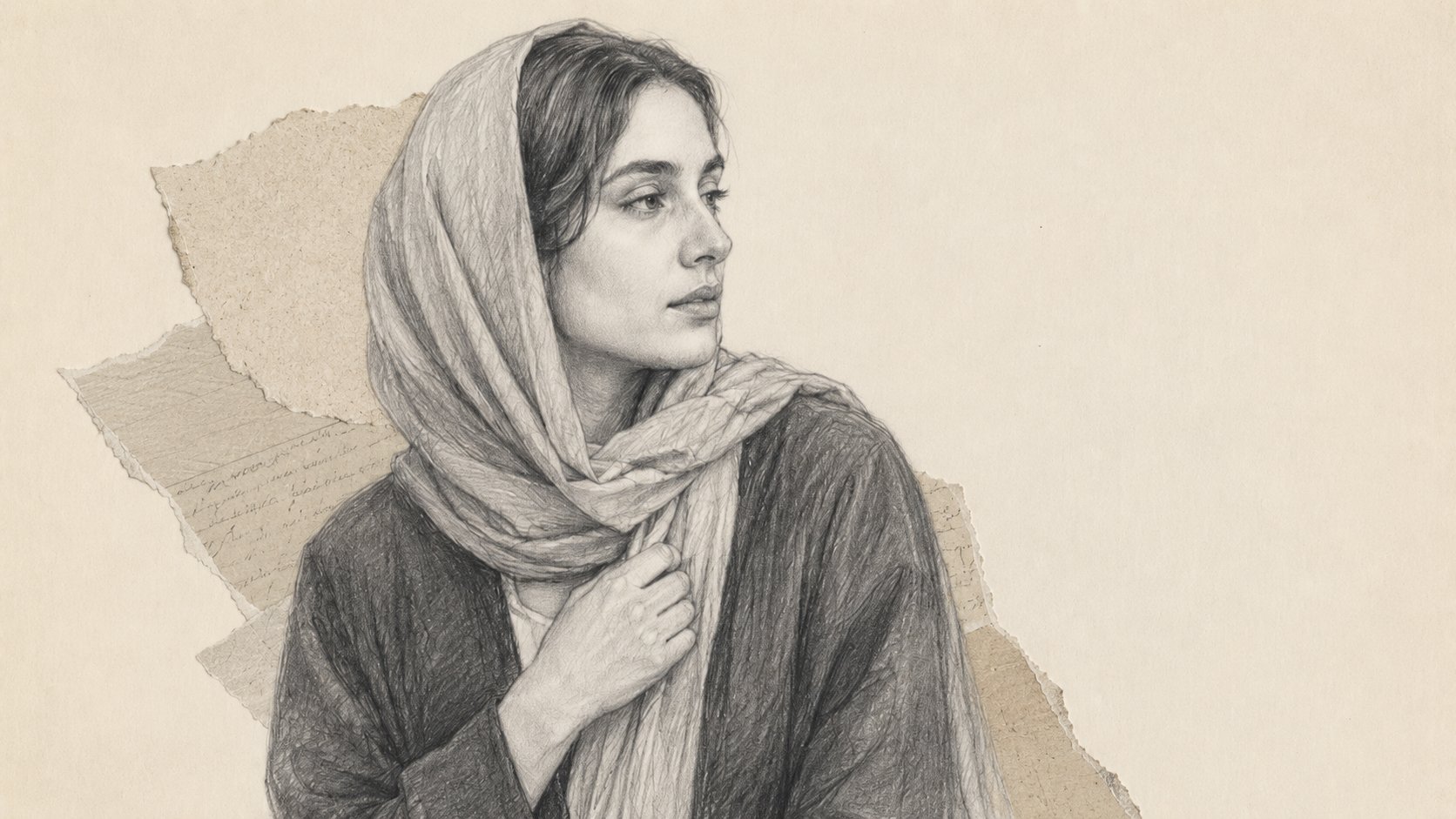
When cloth surrounding the head is black, the face often becomes the brightest remaining field. This intensifies expression, gaze, and skin contrast in photographs and film stills.
Body scale
The outline grows larger than the body
Drape expands the visible perimeter. The garment’s outer line can become more important than anatomical shape, replacing fitted display with moving volume.
Surface discipline
Ornament recedes but texture remains
Black suppresses small decorative signs from a distance, yet close reading reveals weave, edge, sheen, crease, dust, weight, and wear.
Cinema, photography, and the visual authority of darkness
Post-revolutionary cinema is essential to any history of black dress because film turned clothing rules into visual grammar. The issue was not only what women could wear, but how bodies could be staged, touched, framed, lit, and narrated. Cinema Iranica’s discussion of women’s cinema in post-revolutionary Iran is useful here because it shows how representation, cultural regulation, and cinematic practice became entangled after 1979. For fashion history, this means cinema is not merely illustration. It is an archive of silhouettes, codes, gestures, and negotiated visibility.
Black reads powerfully on camera. It simplifies the figure into contour, increases contrast with skin and background, and creates an immediate relationship between body and negative space. In black-and-white photography, a chador or dark coat can become almost graphic: a shape before it is a garment. In color film, black may absorb visual noise, making the figure seem solemn, contained, or monumental. But this authority is unstable. A dark garment can signify mourning in one frame, institutional discipline in another, religious devotion in another, and private resilience in another.
The later international visibility of Shirin Neshat’s black-and-white imagery demonstrates how post-revolutionary black entered the global art vocabulary. An open-access MDPI article on Iranian contemporary female artists discusses Neshat’s “Women of Allah” series, including the role of the chador, calligraphy, gaze, and stark tonal contrast; the discussion is available through this study of Iranian women artists and bodily representation. Neshat’s work belongs to the 1990s rather than the 1980s, yet it helps explain the afterlife of the decade’s visual language in the art market and exhibition world.
Archive wall · no images, only reading cues
How to read a dark figure in an archive photograph
Distance
From far away, black produces mass and rhythm: rows, crowds, processions, ceremonies. The garment becomes part of a collective composition.
Gesture
The hand holding a chador closed, the tilt of the head, and the arrangement of a scarf reveal active management rather than passive coverage.
Surface
A crease, shine, weave, or dusty hem can locate a garment in everyday life rather than abstract symbol.
Context
A schoolyard, mosque, street, office, cinema frame, or funeral changes the meaning of the same dark garment.
Material culture: black is never one fabric
A common mistake in discussions of post-revolutionary dress is to speak of black as though it were a flat surface. In material terms, black varies dramatically. Matte black cotton absorbs light and can feel devotional, humble, and everyday. Black crepe has movement and a slightly formal fall. Synthetic black may hold sharper creases, catch urban light, or signal affordability and mass availability. Woolen black carries weight and seasonal seriousness. A black scarf in a thin weave frames the face differently from a heavier one. Even the same color changes with dust, washing, sun exposure, and age.
This is where textile history becomes important. Iranian dress cannot be understood only through law, ideology, or surface iconography. It is also a story of cloth economies, availability, imported and local materials, household purchase decisions, sewing skills, tailoring networks, and the everyday labor of maintenance. Dark clothing requires care: it shows lint, fading, shine at points of friction, and the dulling of dye. These traces are not minor. They are part of the garment’s social biography.
The broader regional-dress context also matters. The Textile Research Centre in Leiden has built an accessible digital exhibition, Beyond the Chador: Regional dress from Iran, which helps remind readers that Iranian clothing history is far more diverse than one metropolitan or state-centered image. Against that diversity, the 1980s prominence of black in many public urban and institutional contexts appears even more striking: it was not the only Iranian dress language, but it became one of the decade’s most powerful public codes.
Fabric hierarchy board
Four black surfaces, four different meanings
Matte cotton
Domestic, washable, practical, and close to daily life. It can read as modest, ordinary, and unadorned.
Slight sheen
A small reflection changes everything. Shine can introduce formality, ceremony, artificial light, and photographic contrast.
Ribbed texture
Texture reintroduces design when color is restricted. The surface speaks through touch rather than ornament.
Heavy drape
Weight produces authority. A heavy dark cloth falls slowly, enlarges the silhouette, and gives the body ceremonial gravity.
Why this history matters now
For contemporary fashion designers, the 1980s history of black in Iran offers a lesson in restraint. A narrow palette does not mean poor design. It can intensify proportion, line, layering, fabric behavior, and bodily choreography. Designers interested in heritage should study how minimal color systems produce maximum social meaning, especially when a garment’s force comes from cut, drape, and surface rather than decoration.
For textile artists, this subject opens a field of research into black dye, texture, wear, and light absorption. Black is not visually empty. It is one of the hardest colors to control because small changes in fiber and finish create radically different effects. For curators and museum professionals, the challenge is interpretive: how can a black garment be exhibited without flattening it into ideology? Labels must speak about fabric, use, occasion, wearer, and afterlife, not merely symbolism.
For collectors and art-market observers, the topic explains why photographs, film stills, posters, and textile objects connected to post-revolutionary visual culture have layered value. Their importance may lie not in luxury material but in historical density. A modest garment, a documentary image, or a costume sketch can become valuable when it condenses social transformation, gendered visibility, and design intelligence. The art market often rewards recognizable icons, but serious collecting also depends on contextual knowledge.
For brand designers and cultural entrepreneurs, the lesson is ethical caution. Black associated with Iranian post-revolutionary dress should not be used as an exotic sign or instant mood board. Its visual power comes from lived history, mourning, religious culture, state regulation, war memory, and daily negotiation. Responsible heritage use means studying before quoting, crediting before styling, and understanding that beauty can be inseparable from historical pressure.
Market signal · cultural value without sales language
What gives this subject contemporary value?
Archival scarcity
Everyday garments from the 1980s were often used, repaired, discarded, or undocumented. Surviving objects with provenance can become unusually meaningful.
Photographic force
Black garments translate strongly into documentary images, exhibition prints, book covers, and visual essays because they produce graphic authority.
Design relevance
Contemporary designers can learn from the decade’s severe vocabulary: silhouette, restraint, modular layering, matte surfaces, and disciplined proportion.
A responsible way to see
The most responsible reading of black in this period must hold several truths together. Black was connected to mourning and piety. It was also connected to state expectations and institutional discipline. It offered dignity to some wearers and constraint to others. It could be chosen, negotiated, inherited, performed, resisted, or simply worn because the available social world made it practical. Fashion history becomes shallow when it turns garments into one-word meanings.
A deeper reading begins from the object. What is the fabric? How heavy is it? Does it shine? How is it held? What does it hide, frame, reveal, or enlarge? Is it worn in a funeral, classroom, shrine, street, office, or film scene? Is the garment new, faded, repaired, borrowed, uniform-like, handmade, factory-made, urban, rural, ceremonial, or ordinary? These questions restore the intelligence of dress.
In this sense, the black surfaces of the 1980s belong to Iranian visual culture as much as to political history. They shaped how a society pictured seriousness, virtue, grief, gender, collectivity, and public life. They also left a visual archive that remains potent for artists, designers, and scholars today.
Curator’s note
The key is not to ask what black means, but how black works
Black works by absorbing light, disciplining ornament, enlarging contour, framing the face, harmonizing bodies with ceremony, and turning ordinary movement into graphic form. It can carry grief without being only grief. It can signal piety without being only piety. It can register social pressure without erasing the wearer’s design choices.
For a fashion-history archive, this is the central lesson: color is not decoration added to clothing after the fact. Color is structure. In the Iranian 1980s, black became one of the structures through which public dress was seen, regulated, remembered, and reimagined.
Closing reflection
To study black in Iranian dress during this decade is to study the meeting point of cloth and historical mood. The color gathered mourning, devotion, authority, modesty, pressure, and adaptation into one unusually dense visual language. Yet it never became a single meaning. Its complexity lies precisely in the fact that it could be solemn and practical, devotional and bureaucratic, collective and personal, visually severe and materially nuanced.
For contemporary readers, the subject offers a way to look beyond cliché. The black garment is not only a symbol to be decoded from outside. It is a designed object, a social surface, a moving architecture, and an archive of lived negotiation. The more carefully one studies its fabric, edge, fall, and context, the more visible Iranian dress history becomes.
Editorial takeaway
The most powerful lesson of this chromatic history is that black should be read as a material and visual system. It shaped silhouette, public mood, religious atmosphere, mourning culture, cinematic contrast, and contemporary art memory. Its importance lies not in a single political reading, but in the way one color reorganized the appearance of a decade.
Correspondence and cultural conversation
For correspondence, discussion, collaboration, research questions, event updates, exhibitions, and cultural programs related to Iranian dress history and visual heritage, readers are warmly invited to contact Heritage by Sanaz.
Direct WhatsApp message
For a direct and calm conversation about cultural programs, fashion-history research, design heritage, or collaboration, you may also send a WhatsApp message to +351914016396.