Cart 0

Research Essay · Iranian Visual Culture · Dress and Image
When explicit glamour becomes difficult to stage, style does not simply disappear. It migrates. It enters the edge of a sleeve, the angle of a scarf, the cropped fragment of a hand, the controlled brightness of a studio wall, the tactility of black fabric, the borrowed language of portraiture, and the quiet intelligence of composition. In modern Iranian image culture, especially after the 1979 Revolution, fashion often had to operate in precisely this displaced register: present, legible, and aesthetically sophisticated, yet rarely named as fashion in the straightforward commercial sense familiar from Paris, London, or New York magazine traditions.
This article argues that Iranian fashion imagery after the Revolution is best understood not only through formal fashion shoots, catalogues, and advertisements, but through a wider archive of indirect representation: women’s magazines, studio portrait conventions, street photographs, contemporary art photography, cinema stills, museum objects, and digital street-style fragments. The available visual evidence suggests a culture in which dress continued to generate meaning through surface, gesture, framing, and social legibility, even when the conventional fashion photograph became unstable, constrained, or ideologically burdened.
Research question and thesis
The central research question is this: how did fashion aesthetics survive in Iranian visual culture when overt fashion display became politically, morally, and institutionally complicated? The answer requires moving beyond a narrow definition of fashion photography as a commercial image of a model wearing a garment. The Victoria and Albert Museum’s overview of fashion photography reminds us that fashion photography has always been entangled with portraiture, celebrity, social aspiration, commercial persuasion, and changing roles for women. In Iran, these relationships were further intensified by state regulation, religious symbolism, gendered visibility, and the long historical memory of veiling and unveiling.
The thesis here is not that Iranian visual culture lacked fashion photography after 1979. Rather, the claim is more precise: a great deal of Iranian fashion meaning appeared in images that did not always announce themselves as fashion images. Photography of women in public space, portraits by artists such as Shadi Ghadirian and Shirin Neshat, newspaper and magazine imagery, and later digital street-style documentation all show how dress could become aesthetic argument. Fashion survived by becoming oblique. It shifted from frontal spectacle to coded visibility.
The research approach is therefore interdisciplinary. It reads photographs as visual evidence, garments as designed systems, and public dress as material culture. It draws on institutional archives such as the Smithsonian National Museum of Asian Art’s Iran in Photographs project, historical dress research from Encyclopaedia Iranica’s clothing index, museum discussions of Iranian art, and contemporary photography sources from institutions including the National Museum of Women in the Arts, the Guggenheim, the MFA Boston, and the Museum for Islamic Art in Berlin.
Primary question
How can fashion be photographed when direct glamour is visually, morally, or politically constrained?
Material evidence
Scarves, manteaux, chadors, coats, handbags, shoes, textile surfaces, studio backdrops, street poses, and archival captions.
Visual hypothesis
Under constraint, fashion meaning often moves into crop, texture, gesture, layering, repetition, and the tension between concealment and style.
Historical context: from court portraiture to post-revolutionary image discipline
Iranian dress has long been mediated by image systems. Qajar paintings and photographs were not merely records of clothing; they organized visibility, status, gender, ethnicity, and access to power. The Encyclopaedia Iranica entry on daguerreotype notes the early arrival of photography in Persia in the 1840s, while the Smithsonian’s introduction to photography in Iran places Qajar photographic practice within courtly patronage, European travel, technical experimentation, and the emergence of studios in Tehran.
In the Qajar period, dress was visibly theatrical. Portraits often emphasized textiles, jewelry, hats, weapons, turbans, veils, and embroidered surfaces. The Smithsonian exhibition The Prince and the Shah describes Qajar portraiture as a field where Persian artists transformed the representation of royalty and nobility while negotiating new technologies and European conventions. In this visual world, clothing was not background. It was one of the central languages through which identity was staged.
The Pahlavi period introduced a different regime of fashion modernity. State-led modernization, urban consumer culture, women’s magazines, cinema, and imported fashion imagery made dress a visible sign of national transformation. Yet this history was never simple. Encyclopaedia Iranica’s discussion of clothing in the Pahlavi and post-Pahlavi periods makes clear that modern dress reform, class differentiation, regional dress, and public visibility changed unevenly across time and place. Fashion in Iran has repeatedly been pulled between elite display, state policy, urban aspiration, religious norms, and private taste.
After 1979, this visual field was reorganized. Women’s public dress became subject to new legal, social, and symbolic pressures. A cinema-focused Iranica article on the construction of the “decent woman” in early post-revolutionary Iranian films notes the gradual compulsory status of hijab and the 1983 law concerning women’s clothing. For fashion imagery, this mattered profoundly: the body, the garment, and the image no longer belonged only to taste or commerce. They became part of a public negotiation over virtue, modernity, authority, femininity, and representation.

The source landscape: what survives, and what remains difficult to prove
The evidence for Iranian fashion imagery is scattered. Some material survives in museums, but much remains dispersed across private albums, magazine scans, commercial studios, state archives, family collections, exhibition catalogues, auction records, and online repositories. The Harvard Library’s Women’s Worlds in Qajar Iran demonstrates how rich the archive can become when personal papers, photographs, publications, and everyday objects are brought together. Yet for the late twentieth century and post-revolutionary decades, the archive is more politically uneven and often harder to access.
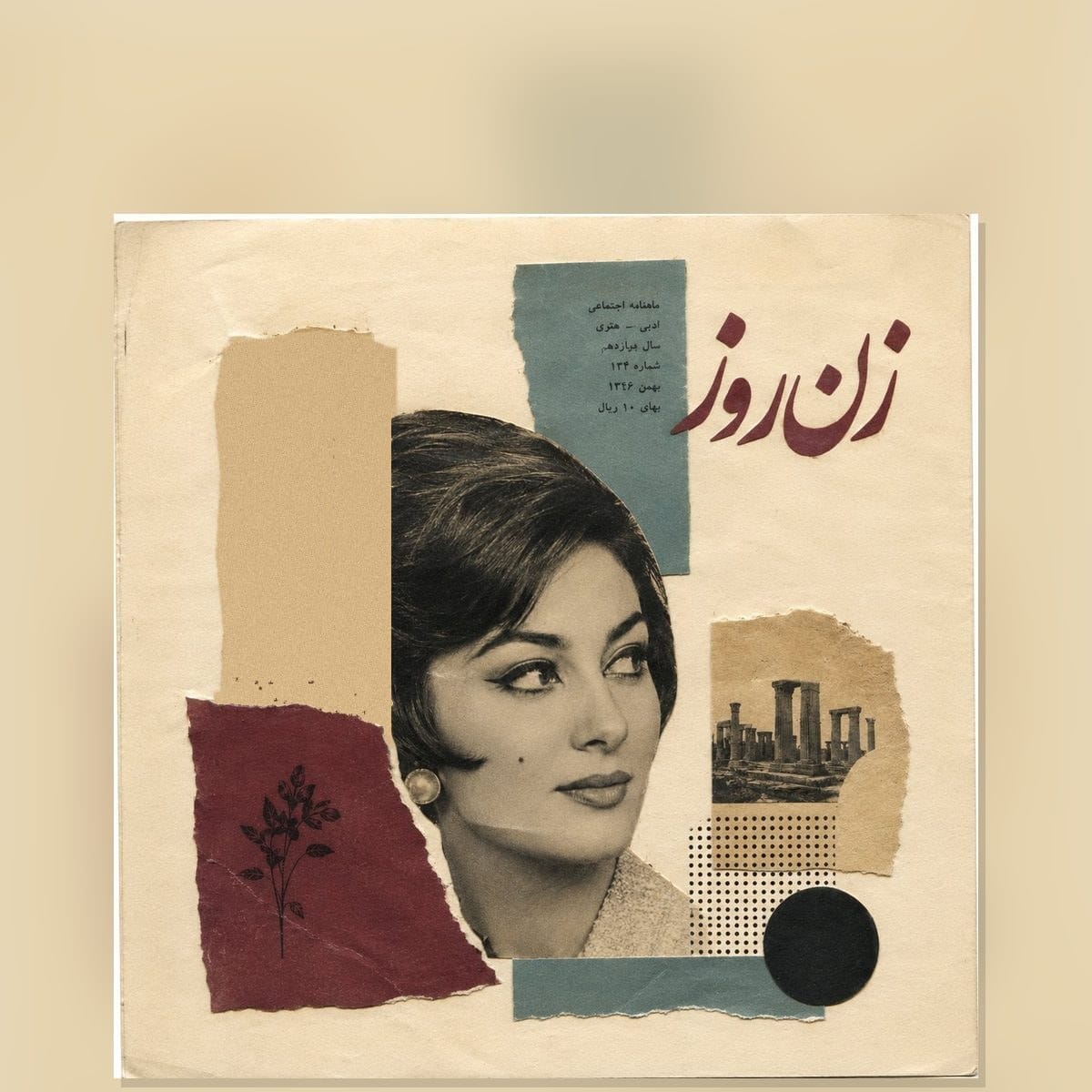
Magazine culture is especially important. Pahlavi-era women’s magazines such as Zan-e Rooz connected beauty, domesticity, celebrity, education, and social modernity; a scholarly article in the Journal of Iranian Cultural Research on Zan-e Rooz and women’s identity is useful for reading such magazines as ideological and visual documents rather than as light entertainment alone. After the Revolution, the question becomes less whether fashion imagery existed and more how its codes changed: what could be shown, what had to be cropped, what became acceptable through modesty, and what could be smuggled into gesture or textile detail.
The available visual evidence should therefore be read cautiously. A single image cannot prove a universal dress code. A studio portrait does not represent all women. A street photograph may show one neighborhood, class position, or moment. A museum object may privilege elite or collectible forms. A magazine page may reveal editorial aspiration more than daily practice. Rather than proving a single rule, the material record helps us see a pattern: Iranian dress images often make meaning through negotiation between visibility and restraint.
| Source type | What it reveals | Main limitation |
|---|---|---|
| Museum garments and textiles | Cut, material, embroidery, color, preservation, elite taste | Often detached from everyday wear and original social use |
| Studio photographs | Pose, social aspiration, surface detail, self-presentation | Staged conventions may obscure daily reality |
| Women’s magazines | Editorial ideals, beauty codes, consumer vocabulary | Incomplete digitization and changing political constraints |
| Contemporary art photography | Allegory, critique, quotation of older visual forms | Artistic staging should not be mistaken for direct ethnography |
| Street-style images | Layering, improvisation, public negotiation, urban taste | Highly selective and often dependent on platform circulation |
Material analysis: clothing as a designed system under pressure
To study fashion imagery in post-revolutionary Iran, one must read clothing as a system of design decisions rather than as a single ideological sign. The scarf is not just a scarf. Its color, looseness, thickness, print, placement, and relation to hair all matter. The manteau is not merely a modest outer garment. Its length, shoulder line, waist shaping, button placement, textile weight, and relationship to trousers or shoes create a grammar of silhouette. The chador is not visually empty blackness. Its surface absorbs and reflects light differently depending on fabric, movement, and photographic exposure. The available visual evidence suggests that Iranian dress codes produced an unusually sensitive field of small variations.
This is why crop and texture became so important. A fashion system that cannot always rely on the exposed body may intensify attention to textile surface, sleeve proportion, layered hems, tonal contrast, and gesture. The MDPI study on the veiling issue in twentieth-century Iran emphasizes that the veil has carried cultural, social, religious, aesthetic, and political meanings. This multiplicity is crucial: the veil is not a fixed symbol but a material object whose meaning changes according to context, wearer, image, and viewer.
Material-culture analysis also helps us avoid reducing Iranian women’s dress to oppression alone. Restriction is part of the historical picture, but it does not exhaust the visual field. Within limits, women and designers have used color, patterned scarves, unusual coats, shoes, bags, cosmetics, sleeve shapes, and photographic pose to produce difference. This is a history of constraint, but also of visual intelligence. It is a history of small decisions carrying large meanings.
The distinction between local and imported references is also important. Iranian fashion images often draw simultaneously on domestic textile memory, Qajar portraiture, global modest fashion, European magazine photography, Instagram street style, and the commercial language of boutiques. The result is rarely pure tradition or pure globalization. It is more often a layered image economy in which a scarf can read as modesty, aesthetic accent, color field, frame for the face, and marketable style element at the same time.

Visual culture: crop, gesture, and the politics of indirect display
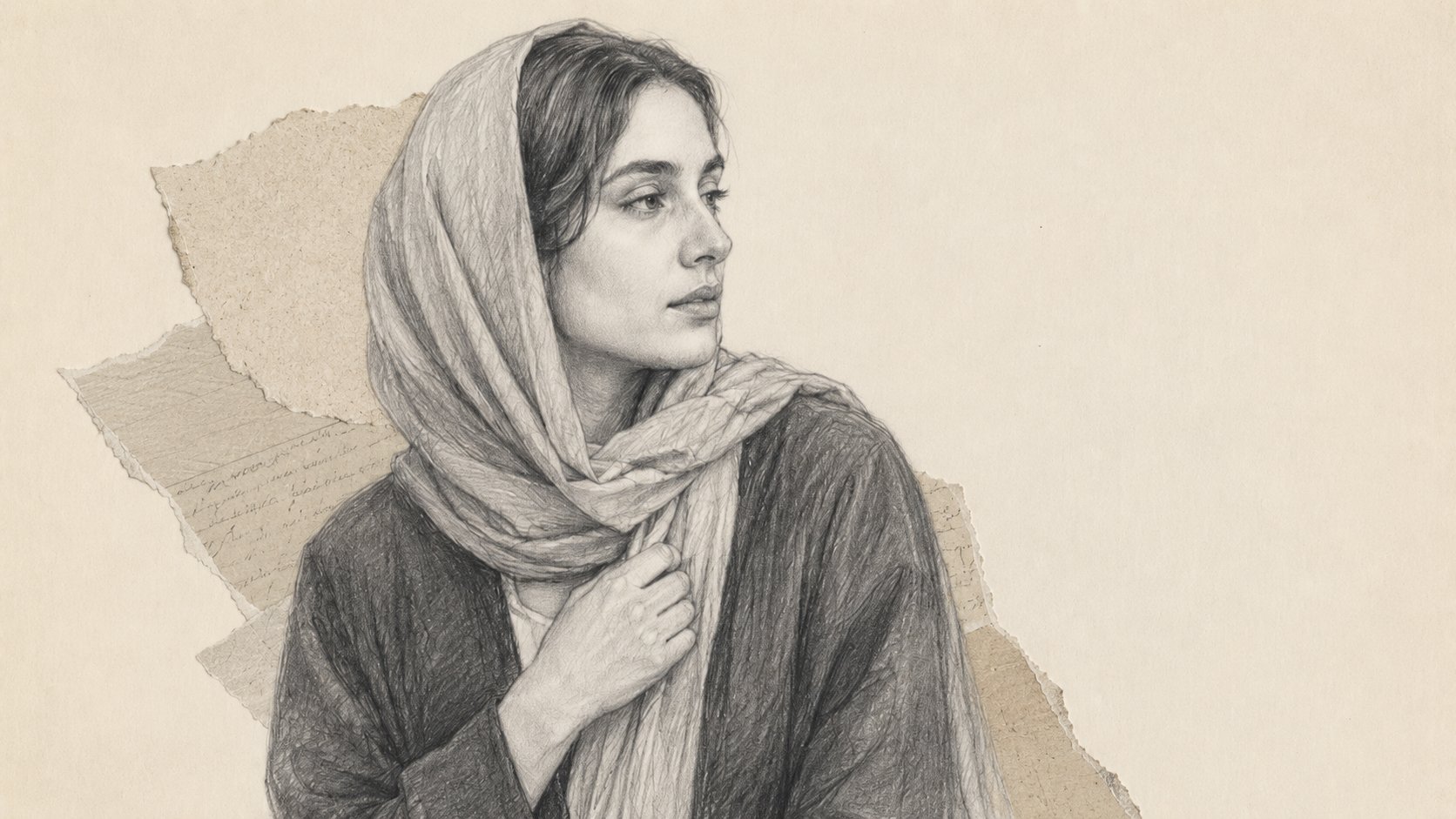
In conventional fashion photography, the garment is usually offered to the viewer as an object of desire. In Iranian visual culture after 1979, desire often had to be displaced. Aesthetic attention might move to the eyes, the hand, the bend of a wrist, the fall of a scarf, the contrast between a black garment and a brightly colored handbag, or the tension between a controlled public pose and a private sense of style. The image may no longer say “buy this dress,” but it still teaches the viewer how dress can be read.
Contemporary Iranian women photographers have been especially important in making this indirect grammar visible. The National Museum of Women in the Arts notes that Shadi Ghadirian’s work explores female identity, censorship, and gender roles; its article on Ghadirian in She Who Tells a Story explains that her Qajar series emerged from her engagement with nineteenth-century Iranian portrait archives. Ghadirian’s method is instructive for this article because she does not simply photograph fashion. She stages time. She places historical clothing conventions beside modern objects, making the viewer understand that dress is both memory and commentary.
The Museum for Islamic Art in Berlin’s feature Through Shadi Ghadirian’s Lens similarly frames her Qajar series through photography, identity, audience, and historical reference. A Cambridge University Press article on photography, performance, and anachronism in the Qajar series is also valuable because it points toward the performative nature of historical restaging. In Ghadirian’s images, clothing is never neutral costume. It becomes a device for making time visible.
Shirin Neshat’s early photographic works offer another model of indirection. The Guggenheim’s artist page for Shirin Neshat identifies the Women of Allah series as work that explores femininity in relation to Islamic fundamentalism and militancy, while Smarthistory’s discussion of Rebellious Silence emphasizes the complexity of identity, Western representation, and personal conviction. These images are not fashion photographs in a commercial sense, but they depend on garment, veil, face, hand, calligraphy, and photographic framing. They show how clothing can become the surface on which political and aesthetic meanings are written.
Chronology note
A useful chronology moves from Qajar court and studio photography, to Pahlavi fashion-modernity and magazine culture, to post-1979 regulation of public dress, to the 1990s and 2000s emergence of internationally visible Iranian women photographers, and finally to digital street-style and modest-fashion circulation. The same problem recurs in different forms: how can clothing make identity visible without becoming visually or politically overexposed?

The post-revolutionary image field: modesty, visibility, and coded distinction
The early post-revolutionary decades reorganized Iranian visual culture around new ideals of public femininity. Yet the story was not a simple disappearance of fashion. It was a transformation of fashion’s channels. In cinema, press imagery, family photography, and public space, women’s bodies were framed through new visual conventions. The Iranica Cinema essay on women and home in Iranian cinema is useful here because it shows how indoor and outdoor spaces, bodily exposure, and gendered codes changed across pre- and post-revolutionary film culture.
The logic of indirection can also be seen in the relationship between public uniformity and private differentiation. Black chador, dark manteau, and regulated covering may appear to narrow the visual field. But even a narrow field permits variation. The chador can be worn with different degrees of looseness, paired with different bags or shoes, moved by different gestures, or photographed from different angles. The scarf can be bright, neutral, floral, geometric, tightly fixed, loosely draped, or used as a color accent. The manteau can create a column, a trapeze, a tailored line, or a soft layered silhouette.
This helps explain why fashion photography could become atmospheric rather than declarative. Instead of a full-body glamour pose, an Iranian image-maker might photograph a shoulder, a patterned textile, an ambiguous domestic interior, an old studio backdrop, a woman’s face divided by a veil, or a model-like pose embedded in everyday architecture. Such images do not reject fashion. They relocate it into the codes of visual culture.
The available scholarship on contemporary Iranian women artists supports this reading. A 2024 article in Arts on Iranian contemporary female artists and the body discusses artists including Neshat, Parastou Forouhar, and Ghadirian in relation to female embodiment. Such work matters for fashion history because it shows that the dressed body became one of the major sites where Iranian artists negotiated representation, power, memory, and agency.

Magazine memory and the afterlife of glamour
The history of Iranian fashion imagery cannot be separated from magazines. In the Pahlavi period, women’s magazines circulated ideals of the modern woman, domestic style, beauty, education, celebrity, and social participation. After 1979, magazine imagery continued to matter, but the semiotics changed. Faces, hair, garments, cosmetics, and bodily pose were edited through new moral and visual constraints. This did not eliminate aesthetics; it made aesthetics more coded.
The importance of women’s press in Iran has deeper roots. Encyclopaedia Iranica’s entry on Zabān-e Zanān describes it as the first newspaper founded and published by a woman in Iran that forcefully addressed women’s rights. This earlier history matters because it shows that women’s print culture in Iran was never merely decorative. It linked language, reform, body, public presence, and modern identity.
A fashion photograph in such a context is never simply a product image. It is a negotiation with social visibility. In a Western fashion magazine, the drama may arise from luxury, fantasy, sexuality, or celebrity. In Iranian post-revolutionary fashion-related imagery, drama often arises from threshold conditions: what is shown and withheld, what is modern and acceptable, what is beautiful but not explicitly glamorous, what belongs to personal style but appears in a public image.
This is why indirect fashion imagery may be more revealing than official fashion promotion. A candid street photograph, a modest studio portrait, or an artist’s staged historical parody may tell us more about the lived negotiation of dress than a formal advertisement. Within the limits of accessible documentation, such images show how Iranian style culture often works at the level of nuance.
Crop
A partial sleeve, a face framed by scarf, or a hand against black fabric can carry the visual charge once assigned to the full glamour pose.
Texture
Matte black, printed chiffon, denim, leather, wool, and polished accessories create difference even within modest silhouettes.
Gesture
How a scarf is held, how a bag is carried, or how a figure turns from the camera can become a coded fashion statement.
Composition
Walls, domestic interiors, streets, and old studio backdrops can transform clothing into visual culture rather than product display.

Street style and the return of the fashion image by other means
By the 2000s and 2010s, digital circulation complicated the post-revolutionary visual regime. Fashion images could appear through boutique pages, personal photography, diaspora platforms, Telegram channels, Instagram, online magazines, and street-style documentation. The line between ordinary portrait, commercial image, and fashion photograph became increasingly unstable. This instability is not a weakness for research; it is the very condition that must be studied.
Street-style imagery is especially revealing because it shows fashion outside the studio. Yet it remains selective. A street-style image is not a census of dress. It usually records what the photographer found visually interesting, socially legible, or platform-worthy. Still, these images matter because they show the practical design vocabulary of urban dressing: layered coats, leggings, sneakers, scarves used as graphic accents, sunglasses, handbags, and color-blocking.
This is also where global modest fashion intersects with Iranian conditions. In global markets, modest fashion can be commercial, aspirational, and brand-driven. In Iran, it carries additional political and social weight. The same long coat may be read as modest, stylish, compliant, resistant, fashionable, ordinary, or all at once. The evidence should be read as a visual and material tendency rather than a fixed universal code.
A useful comparison comes from the V&A’s broader framing of fashion photography as a field shaped by culture and world events. Iranian street-style images confirm this point from another angle: clothing choices and photographic choices are never isolated from political atmosphere, urban space, gender norms, class aspiration, and platform economies.

Museum, archive, and collecting relevance
For museums and archives, indirect fashion imagery poses both an opportunity and a challenge. The opportunity is that it expands the archive beyond garments alone. Photographs, magazine pages, catalogues, press clippings, social media screenshots, and artist books can all become evidence for dress history. The challenge is that many of these materials are fragile, scattered, copyrighted, politically sensitive, or poorly catalogued.
Institutional photographic archives show how useful careful cataloguing can be. The Smithsonian’s Album of Persian Photographs collection record identifies clothing and dress, hairstyles, headgear, jewelry, women, studio portraits, and Qajar dynasty materials as important subject categories. Such cataloguing makes it possible for fashion historians to find visual evidence that might otherwise be hidden inside general photographic collections.
The Library of Congress offers another model. Its record for Qajar paintings commissioned by Justin Perkins describes watercolor images of clothing and customs in Urmia during the late 1830s, while the related object record A Mohamedan on the street explicitly indexes face veils and women’s clothing. These older examples remind us that dress history depends on metadata as much as on images. If clothing is not described, it becomes difficult to research.
For collectors and art-market observers, contemporary Iranian photography has already become a significant field. Christie’s has offered Shadi Ghadirian’s Untitled from the Qajar series, while Sotheby’s lists works by Shirin Neshat and has offered Ghadirian’s Untitled from the Like Everyday series. The market significance of these works is not simply monetary. It confirms that images built from veils, domestic objects, historical dress quotation, and indirect bodily presence have become part of the global language of contemporary art.
Contemporary design relevance
For contemporary fashion designers, this history offers a powerful lesson: constraint can sharpen design vocabulary. When the body cannot be used as an easy spectacle, the garment must work harder through proportion, texture, movement, and detail. Designers interested in Iranian heritage can study the indirect image not as a limitation but as a sophisticated visual grammar.
For textile artists, the lesson lies in surface. Iranian fashion imagery repeatedly shows the importance of textile behavior: how black absorbs light, how printed scarves frame the face, how embroidery changes the reading of a cuff, how matte and glossy surfaces alter photographic tone, and how woven memory can survive in contemporary silhouettes. The Metropolitan Museum of Art’s essay on fashion in Safavid Iran is historically distant from the post-revolutionary period, but it remains relevant because it shows how Iranian dress traditions have long valued color, figural motifs, gold and silver-wrapped threads, and rich textile surfaces.
For curators and museum professionals, the topic demands a broader collecting strategy. A complete exhibition on Iranian fashion photography should not show only formal fashion images. It should include studio portraits, magazine spreads, artist photography, public dress images, garment fragments, fashion ephemera, and legal or editorial documents. It should also explain what cannot easily be shown: missing magazines, inaccessible archives, unrecorded private albums, and images that circulated informally.
For brand designers and cultural entrepreneurs, the subject offers a caution. Heritage cannot be reduced to decorative motifs. Ethical use of Iranian visual heritage requires attention to context, authorship, gendered history, and the difference between inspiration and extraction. The strongest contemporary work does not merely borrow Qajar clothing or post-revolutionary visual codes. It understands why those codes mattered.
Market and professional relevance
| Designers | Learn how silhouette, scarf, sleeve, and textile can carry meaning without overt spectacle. |
| Curators | Build exhibitions that connect garments, photographs, magazine culture, and contemporary art. |
| Collectors | Understand why Iranian photography using dress and veiling has entered international auction and museum circuits. |
| Visual researchers | Read indirect evidence through pose, crop, caption, metadata, and image circulation. |
| General readers | See Iranian dress history as a subtle field of beauty, negotiation, memory, and identity. |
Conclusion: fashion as displaced evidence
The most important conclusion is that fashion does not vanish when conventional fashion photography becomes constrained. It changes location. In Iranian visual culture, especially after the Revolution, fashion often appears as displaced evidence: a scarf that becomes a color field, a chador that becomes a study in black surface, a handbag that interrupts uniformity, a Qajar costume that returns as contemporary critique, a street pose that quietly borrows from global fashion imagery, or a magazine image that teaches taste while avoiding overt glamour.
This history asks researchers to look more carefully. The archive is not always where we expect it to be. It may be in a museum record, a family portrait, a contemporary artwork, an old women’s magazine, a public-space photograph, or a digital image whose fashion meaning lies in tiny compositional decisions. Iranian dress history, read through this lens, becomes a history of visual intelligence under changing conditions of power.
For Heritage by Sanaz and for anyone invested in Iranian clothing heritage, the lesson is profound. Fashion history is not only the history of garments. It is the history of how garments become visible, how visibility is managed, and how beauty survives through indirection.
Editorial takeaway
The indirect Iranian fashion image teaches us to read slowly. When direct glamour narrows, aesthetics may move into the edge, the fold, the crop, the surface, and the gesture. This does not make fashion less important. It makes fashion more archival, more interpretive, and more deeply connected to visual culture.
Research notes and sources
The article’s historical frame draws on Encyclopaedia Iranica’s general remarks on clothing, its entry on Qajar art and architecture, and its entry on Antoin Sevruguin. The photographic archive discussion draws heavily on the Smithsonian’s Iran in Photographs and its essays on Passages: Studio to Archive.
The contemporary art discussion is supported by the National Museum of Women in the Arts exhibition She Who Tells a Story, the Museum of Fine Arts Boston press material, the Guggenheim’s Shirin Neshat artist record, and The Broad’s exhibition page Shirin Neshat: I Will Greet the Sun Again. Market references include Christie’s, Sotheby’s, Phillips, and the MDPI article The Emergence of an Auction Category: Iranian Art at Auction.
Continue the conversation
For correspondence, discussion, collaboration, questions, event updates, cultural programs, and fashion-history conversations, Contact Heritage by Sanaz.
Direct message
For a direct conversation, send a WhatsApp message to +351914016396 through this link: Send a direct WhatsApp message.