Cart 0

Research Essay · Early Pahlavi Dress History
In the early Pahlavi decades, women’s outerwear became one of the most visible sites where modernity was cut, stitched, photographed, regulated, desired, resisted, and displayed. The coat did not simply replace an older garment. It reorganized the public outline of the body: shoulder, waist, hem, stride, hat, glove, shoe, handbag, and the new photographic grammar of urban appearance.
Research question and thesis
The central question of this essay is precise: how did women’s coats and related outerwear help produce a new street silhouette in Iran during the reign of Reza Shah, and what can that silhouette tell us about design, gender, class, photography, and state power?
The thesis is that the early Pahlavi coat should be read less as a simple emblem of “Westernization” and more as a designed interface between the female body and the modern street. The available visual evidence suggests a shift from enveloping outer covering toward tailored or semi-tailored forms that made posture, movement, individual outline, and public legibility newly important. This shift was uneven, urban, classed, politically charged, and mediated by photography and institutional ceremony. It was not a universal code worn by all women, but a visual tendency visible in surviving photographs, educational images, state ceremonies, and elite or middle-class representations.
The historical frame is the early Pahlavi period, especially the 1920s and 1930s. Any responsible discussion must begin with the broader dress reforms and the forced unveiling policy. Encyclopaedia Iranica’s entry on clothing in the Pahlavi and post-Pahlavi periods notes that some educated women had already begun appearing at private functions with hats rather than veils before the 1936 public unveiling ceremony, and it situates the policy within Reza Shah’s modernizing program. The chronology matters: dress reform was not only a matter of fabric; it was part of a state project that linked appearance, discipline, education, nationalism, and public order.
At the same time, the coat should not be swallowed by political history alone. A garment has weight, cut, closure, sleeve shape, surface, lining, and a way of moving with or against the body. The most fruitful reading therefore combines dress history, textile studies, photographic analysis, and social history. In this approach, the coat becomes evidence of a changing public body: not only unveiled or veiled, but lengthened, shortened, belted, buttoned, hatted, seated, standing, walking, photographed, and made visible within new urban scenes.
Primary research question
How did coat cut, hemline, shoulder line, and movement reshape women’s public silhouette in early Pahlavi visual culture?
Secondary questions
What kinds of women appear in surviving images? Which garments are visible? How do photographs transform clothing into social evidence?
Design angle
The essay reads the coat as a mobile architectural form: an outer shell that frames the body for streets, schools, ceremonies, and camera lenses.
Historical context: reform, education, and public appearance
The early Pahlavi state sought to centralize authority, standardize institutions, expand state education, and discipline public life. Dress was drawn into this larger apparatus. Iranica’s survey of feminist movements in the Pahlavi period describes Reza Shah’s reforms as policies that radically altered women’s lives through secularizing and modernizing programs, while also emphasizing their authoritarian character. This double movement is essential: new forms of female public visibility were created, but often under coercive conditions.
The 1936 unveiling ceremony at the Teachers’ Training School in Tehran has become one of the most cited episodes in Iranian dress history. Iranica’s entry on ʿAli-Aṣḡar Hekmat explains that Hekmat was charged with mapping the plan for unveiling and describes the public ceremony attended by the Shah, Queen, princesses, ministers’ wives, and dignitaries. Iranica’s chronology of Iranian history also records 1936 as the year when the Queen and daughters appeared unveiled at the new Teacher’s Training School and when women were banned from wearing the traditional veil.
But if we look only at the decree, we miss the design story. Unveiling did not automatically produce a modern silhouette; garments had to do that work. Hats, coats, skirts, shoes, stockings, handbags, collars, and gloves formed a complete street system. The coat was central because it stood at the threshold between interior dress and public exposure. It could cover while also outlining. It could signal modesty while introducing tailoring. It could translate the body into a vertical urban form legible in schools, ceremonies, promenades, offices, and photographs.
Education was one of the social arenas where this transformation became visible. Iranica’s general survey of modern education notes that a national system of modern education emerged in Persia in the 1920s and 1930s after the founding of the Pahlavi state. Iranica’s entry on higher education situates Reza Shah’s interest in higher education within the state’s modernization agenda. Schools and universities were not merely educational spaces; they were also visual stages where the dressed female body could be presented as disciplined, literate, mobile, and publicly acceptable.

The source landscape: what survives, and what does not
The evidence for women’s early Pahlavi outerwear is uneven. Surviving garments from everyday Iranian women are limited, and when garments survive they are often disconnected from the original wearer’s biography. Photographs survive in greater numbers, but they are selective: studio portraits, school photographs, ceremonies, elite family images, state events, and newspaper reproductions do not represent all women. They overrepresent urban, literate, elite, middle-class, institutional, or politically staged bodies.
This is why photographs must be read as visual evidence, not transparent windows. The National Museum of Asian Art’s overview of Iran in photographs describes more than 1,100 original prints and glass-plate negatives in its archives, including studio portraits, women, court ceremonies, archaeological sites, landscapes, and street views. Its Sevruguin Resource Gateway emphasizes how widely Antoin Sevruguin’s photographs circulated in travelogues and publications by the 1880s. Although Sevruguin belongs mainly to late Qajar visual culture, his archive helps us understand the photographic habits that shaped later Pahlavi representations: pose, costume, studio staging, social type, and the tension between documentary record and constructed image.
Digital humanities projects are also important. Women’s Worlds in Qajar Iran at Harvard preserves and connects primary materials related to women’s lives in Qajar Iran, making clear that female dress history depends on scattered archives rather than a single national costume record. Harvard Art Museums’ exhibition on technologies of the image in nineteenth-century Iran is useful because it foregrounds the movement of images across media. That insight applies to early Pahlavi coat history too: a street silhouette becomes historically powerful when it circulates as photograph, magazine image, school portrait, ceremony record, and family memory.
| Evidence type | What it can show | Main limitation |
|---|---|---|
| Ceremonial photographs | Official bodies, hats, coats, posture, group discipline | Highly staged and politically selected |
| School and university images | Education, middle-class aspiration, public respectability | Urban and institutional bias |
| Surviving garments | Cut, textile, stitching, lining, repair, material quality | Often detached from wearer and context |
| Magazines and printed images | Fashion vocabulary, aspiration, commercial circulation | May show ideals more than ordinary practice |
Material analysis: the coat as a designed system
A coat is not only an outer layer. It is a technical solution to the problem of appearing outdoors. In early Pahlavi photographs, one sees several design concerns: a more defined shoulder, a visible waist or belt, a hem that permits walking, sleeves that organize the arm, collars that frame the neck, and hats that complete the upper silhouette. The evidence should be read as a visual and material tendency rather than a fixed universal code. Some women appear in dark, plain outerwear; others in lighter coats, patterned dresses, or ceremonial attire. The key change is not one style but a new grammar of bodily outline.
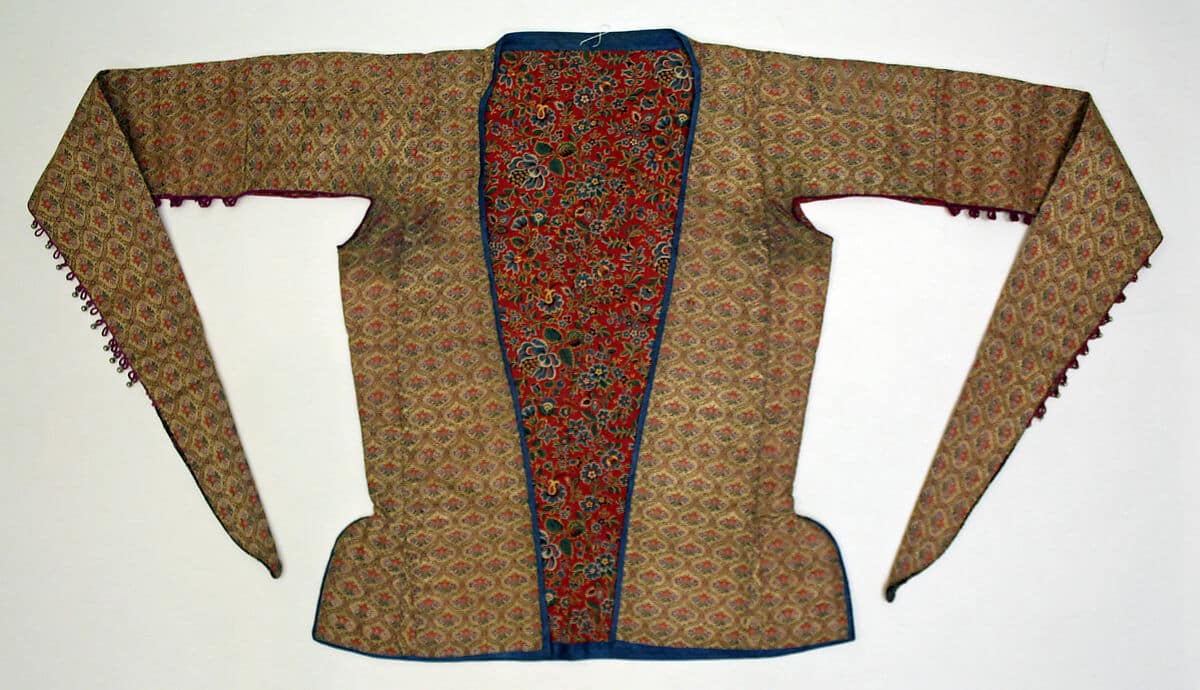
The older Iranian clothing record is rich in robes, jackets, coats, trousers, veils, and layered textile systems. For longer historical comparison, the Metropolitan Museum of Art’s essay on fashion in Safavid Iran describes layered clothing, sumptuous silk outer garments, veils, and footwear in early modern visual sources. The Met’s record for a Persian riding coat also reminds us that cut, flare, closure, and mobility have long mattered in Iranian and Persianate garment history. Early Pahlavi coats were therefore not simply a break with all Iranian precedent. Rather, they rearranged older principles of outer covering through new tailoring, new public conditions, and new photographic visibility.
Textile weight would have been crucial. A heavy wool coat produces a different silhouette from a light woven jacket. It holds the shoulder and falls with gravity; it can conceal the body while preserving outline. A lighter coat permits movement, flutter, and seasonal adaptation. Dark textiles create graphic clarity in black-and-white photographs, while pale coats register as public contrast against darker interiors, uniforms, or architectural backgrounds. The available images do not always permit precise fiber identification, so any claim about wool, cotton, silk, or blended fabric must remain cautious unless attached to a surviving object. Still, the visual record points toward outerwear that increasingly favored surface restraint, tailoring, and legibility over dense ornament.

The 1930s global fashion context matters, but it must be used carefully. The Fashion History Timeline’s overview of 1930s fashion notes the decade’s return from the looser 1920s line toward more shaped, conservative, and film-influenced styles. The Victoria and Albert Museum’s fashion collection provides a broad institutional frame for studying couture, accessories, and twentieth-century dress, while the V&A’s discussion of fashionable womenswear across a century reminds us that silhouette change is often visible through the relation between body, material, and social norm. For Iran, however, those global references must be filtered through local politics, climate, religious practice, class, and the coercive context of unveiling.
Visual culture: photography, posture, and the public body
Photographs of early Pahlavi women often make the coat perform three visual tasks. First, it creates respectability. The coat covers the torso, regulates the outline, and allows a woman to appear in public without appearing visually exposed. Second, it creates modernity through cut and coordination: hat, collar, hem, and shoe work as a unified ensemble. Third, it creates movement. A woman in a coat can stand, sit, walk, attend school, watch a race, or join a ceremony. The garment helps the body enter public space as a socially readable figure.
This visual readability was never neutral. Firoozeh Kashani-Sabet and other historians of modern Iran have emphasized how gender and nation were repeatedly linked, but here the material detail matters: national modernity was not only announced in speeches; it was staged through the clothed body. Faegheh Shirazi’s study of the veiling issue in twentieth-century Iran is useful because it frames veiling and unveiling as social, religious, aesthetic, and political fields rather than as a single stable meaning. The same caution applies to the coat. It could signify modern aspiration, state compliance, elite access, educational respectability, or simply practical clothing, depending on wearer and context.
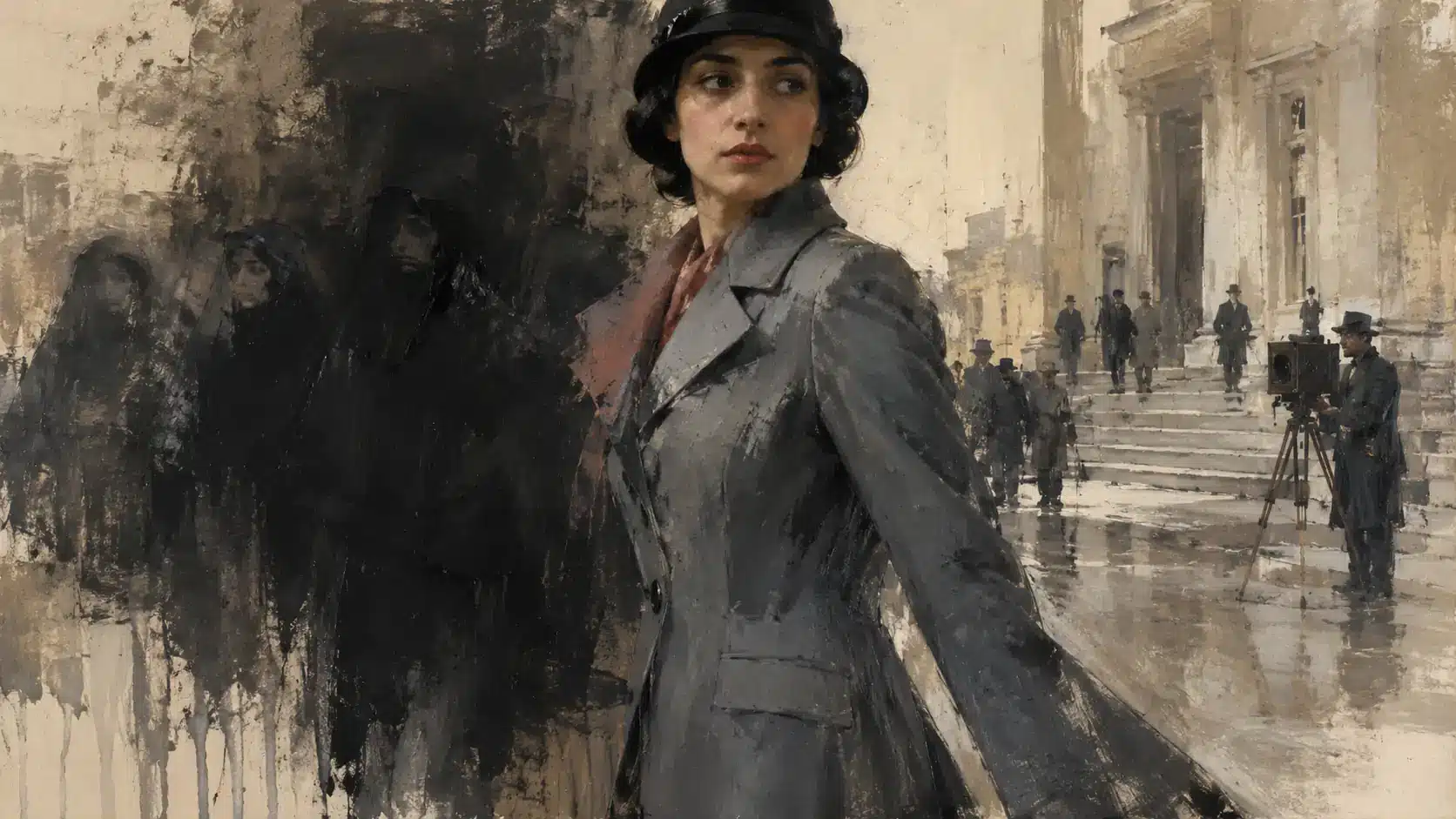
The coat also changes how a woman is framed by the camera. A chador-based street silhouette often appears as a continuous dark volume, with the body’s joints and proportions visually suppressed. A coat-and-hat silhouette divides the body into readable zones: crown, face, collar, shoulder, waist, hem, legs, shoes. This does not make one system more authentic than another; it means that each system produces a different visual logic. Early Pahlavi photographs often favor the new logic because it makes the body legible to state and modernist representation.

Group portraits are especially important because they show the social coordination of silhouette. The body is not merely clothed; it is arranged among other clothed bodies. Similar lengths, similar hats, similar dark-light contrasts, and similar poses create a collective image of female modernity. Yet the archive should not be overread. A university portrait does not tell us what rural women wore, what lower-income women could afford, how women felt about the garments, or how many women avoided public appearance because of coercive policy. Rather than proving a single rule, the material record helps us see a pattern among the women who entered institutional visibility.
Coat, hat, hem: reading the street silhouette
The early Pahlavi street silhouette can be read from top to bottom. The hat replaces or competes with older head covering forms in official modernist imagery. Its brim, crown, or close-fitting shape gives the head a designed contour. The face becomes more exposed to the camera and to the street. The collar then frames the neck: sometimes open, sometimes buttoned, sometimes softened by a blouse. The shoulder is crucial, because it determines whether the coat reads as loose wrapping or tailored architecture. A set-in sleeve produces one effect; a softer shoulder another. The waist may be loose, belted, or lightly shaped. The hemline determines stride and reveals the relation between coat, skirt, stocking, and shoe.
The significance of hemline is often underestimated. A coat that ends above the ankle allows the lower leg and shoe to participate in the silhouette. This produces a modern street rhythm: walking becomes visible. The body is no longer represented mainly as a covered mass but as a mobile vertical figure. In photographs, especially black-and-white images, this verticality is intensified by contrast: dark coat against pale wall, light coat against dark uniforms, hat against sky, shoes against stair or ground.
Ornament also shifts. Earlier elite Iranian garments could carry strong textile pattern, embroidery, metallic thread, and layered visual density. Institutional early Pahlavi outerwear often appears more restrained. This does not mean ornament disappeared; it means the public visual emphasis frequently moved from surface richness toward silhouette, coordination, and discipline. The V&A’s Islamic Middle East collections and the Smithsonian listing for Jennifer Wearden and Patricia L. Baker’s Iranian textiles catalogue remind us how deep and varied Iranian textile traditions are. Against that history, the plain or semi-plain coat becomes visually meaningful: it participates in a modern public language where cut may speak louder than pattern.

Ceremony and coercion: the coat under state visibility
The modern coat’s public rise cannot be separated from the violence of compulsory unveiling. This is where design history must remain ethically alert. Garments can be beautiful, technically interesting, and visually powerful while also being implicated in coercive regimes of public appearance. The early Pahlavi state did not merely permit new forms of dress; it used dress to mark obedience to a modernizing vision. Cambridge University Press’s chapter on male dress reforms under Reza Shah shows that clothing reform affected men as well, especially through state attempts to standardize male appearance. Women’s unveiling must be understood within that wider project of bodily regulation.
In official images, coats, hats, uniforms, and architecture collaborate. The state ceremony photograph makes the female figure part of a larger composition of power. Military uniforms sharpen the contrast: male authority appears in rank, epaulettes, caps, and lines; female modernity appears through hats, light dresses, coats, and public unveiling. The image does not simply document clothing; it produces political theatre. It tells viewers that the new public woman belongs within the modern state’s visual order.

Within the limits of accessible documentation, one can identify a strong distinction between private adoption, elite experimentation, and official enforcement. Some women and families may have found in coats and hats a desirable vocabulary of education, cosmopolitanism, mobility, and urban refinement. Others experienced unveiling as humiliation, danger, exclusion, or coercion. The same coat could therefore carry contradictory meanings. A design historian must resist flattening this complexity into either celebration or condemnation. The garment’s form can be studied closely while its political conditions remain in view.

Class signals and urban legibility
The early Pahlavi coat was not socially neutral. Tailored outerwear required access to fabric, dressmakers, pattern knowledge, imported fashion images, or shops that could translate global styles into local wardrobes. It also required public environments where such clothing could be worn with some social recognition. Iranica’s discussion of class in the Pahlavi period notes the expanding educated strata by the time of Reza Shah’s abdication, including college graduates and high-school students. The coat belonged especially to the visual culture of those urban and educated layers, although not exclusively to them.
Class appears through finish. A well-cut coat with balanced proportions, a coordinated hat, clean shoes, and confident posture suggests access not only to money but to etiquette. A plainer coat may still participate in the new silhouette while signaling more practical use. The difference between elite ceremonial outerwear and everyday public coat is crucial. One image may show state spectacle; another may show leisure; another may show student identity. All are modern silhouettes, but they are not the same social silhouette.
The city matters too. Tehran’s streets, schools, racecourses, ministries, and public ceremonies gave the coat its stage. In rural or smaller-town settings, the social meaning of unveiled outerwear could differ sharply. The evidence is strongest for cities and institutions, weaker for everyday rural life. That imbalance should remain visible in the argument rather than hidden behind generalized statements about “Iranian women.”
Museum, archival, and collecting relevance
For museum professionals and curators, the early Pahlavi coat is valuable because it sits at the intersection of costume, photograph, politics, and urban modernity. A surviving coat without provenance can still be read for material construction, but its interpretive value increases dramatically when paired with photographs, family histories, shop records, school records, or magazine illustrations. The problem is not only preservation; it is contextual reconstruction.
Archives of Iranian photography are central to this reconstruction. The Royal Asiatic Society’s Sevruguin-related photographic holdings show how late Qajar and early Pahlavi photographic materials can be grouped as trades, types, and social scenes. The Getty Research Institute’s collection of Antoin Sevruguin photographs of Persia likewise demonstrates the international dispersal of Iranian photographic evidence. Such archives help scholars trace how the female body was staged before the Pahlavi coat became a dominant sign of official modernity.
The art market has begun to recognize Iranian photographic archives as historically significant objects in their own right. Sotheby’s discussion of a major Qajar photography collection emphasizes the market and archival importance of large bodies of Persian photographs. This matters for dress history because images that were once treated as ethnographic or nostalgic can now be understood as evidence for garment systems, visual modernity, and the social life of clothing.
| Audience | Why this topic matters now |
|---|---|
| Fashion designers | It offers a vocabulary of coat length, shoulder restraint, modest coverage, and urban movement without relying on costume reproduction. |
| Textile artists | It clarifies how plain surface, weight, and cut can become as expressive as dense ornament. |
| Curators and museum professionals | It connects dress objects to archives, state reform, women’s education, photography, and urban history. |
| Collectors and art-market observers | It helps identify why photographs, garments, and ephemera from this period have documentary and cultural value beyond rarity alone. |
| Brand designers and cultural entrepreneurs | It offers a disciplined heritage vocabulary: silhouette, restraint, proportion, and evidence-led storytelling rather than decorative cliché. |
Contemporary design relevance without nostalgia
For contemporary Iranian and diaspora designers, the early Pahlavi coat is a powerful but sensitive source. It should not be copied as a nostalgic symbol of pre-revolutionary freedom, nor dismissed as merely imposed Western clothing. A better approach is analytical: study proportion, movement, urban modesty, restrained surface, and the relationship between coat and public identity. Ethical heritage use requires acknowledging coercion while still learning from material form.
The market relevance is equally nuanced. Historical coats, photographs, school portraits, women’s association images, and fashion ephemera can gain value when they are well-provenanced, visually strong, and connected to larger narratives of Iranian modernity. Leila Sreberny-Mohammadi’s study of the emergence of Iranian art as an auction category helps frame how Iranian cultural production has been shaped within international market categories. Although modern coats and dress photographs occupy a different subfield from contemporary art auctions, the same issue of category-making applies: value depends on how objects are named, contextualized, narrated, and connected to institutional memory.
Auction and museum references for older Persianate coats also help designers and collectors understand the long historical prestige of outer garments. Sotheby’s essay on a royal coat and Christie’s record for a Seljuk or Central Asian silk lampas robe fragment show how robe, coat, textile, and provenance enter the market language of rarity and prestige. Early Pahlavi outerwear may not always carry the same luxury material value, but it can carry exceptional historical and photographic value when linked to women’s public life and modernization.
Conclusion: a new outline, not a simple replacement
The early Pahlavi coat did not simply replace the veil, nor did it merely imitate Europe. It reorganized the visual relationship between women, the street, the state, and the camera. Through shoulder, waist, hem, collar, hat, and stride, the coat created a new public outline. That outline could be aspirational, coercive, elegant, uncomfortable, empowering, classed, disciplined, or contradictory. Its meaning depended on who wore it, who photographed it, who required it, who desired it, and who was excluded by it.
The most responsible interpretation is therefore material and cautious. Surviving photographs and museum-adjacent records point toward a pattern: early Pahlavi women’s outerwear made the body newly legible in public space. But the pattern is not universal, and the archive is not complete. The coat’s importance lies precisely in that tension. It is both a garment and a historical argument: a cut form through which Iranian modernity tried to make women visible, governable, mobile, and photographable.
Editorial takeaway
The early Pahlavi coat is best understood as a research object, not a fashion anecdote. It joins textile weight, tailored form, public movement, women’s education, coercive state reform, photography, class aspiration, and museum afterlife. Its historical value lies not in proving that Iranian women became “modern,” but in showing how modernity itself was cut into the public silhouette.
Research notes and source orientation
The most important source clusters for this topic are dress-history entries such as Iranica on Pahlavi clothing, institutional histories of women and education such as Iranica on feminist movements in the Pahlavi period, photographic archives such as the Smithsonian’s Iran in Photographs project, and comparative fashion collections such as the V&A fashion collection.
For visual culture before and around the Pahlavi transition, the Museum of Islamic Art’s Qajar women exhibition, the Smithsonian’s essay on Sevruguin and African presence in Qajar Persia, and dispersed photographic collections help establish the visual habits against which early Pahlavi coat imagery should be read.
Correspondence and collaboration
For correspondence, discussion, collaboration, questions, event updates, cultural programs, and fashion-history conversations, Contact Heritage by Sanaz.
Heritage by Sanaz welcomes serious dialogue with scholars, artists, designers, curators, collectors, researchers, and readers interested in Iranian clothing heritage and visual culture.
Direct WhatsApp message
Readers may also send a direct WhatsApp message to Heritage by Sanaz at +351914016396.