Cart 0

Editorial Design Study
When Ornament Becomes a Contemporary Design Language
In Iranian dress culture, a motif is rarely just decoration. It can be a memory of courtly textile workshops, a fragment of regional craft, a sign of literary taste, a trace of trade, or a portable archive carried across bodies, garments, ceremonies, and markets. In contemporary Iranian fashion design, heritage motifs become especially powerful when they are not copied as nostalgic surface, but translated into cut, rhythm, proportion, branding, and material intelligence.
This essay reads inherited ornament as a living design resource. It considers how the boteh, floral scroll, cypress, medallion, border, garden geometry, and manuscript-like figure move from historical textiles into modern collections, scarves, coats, eveningwear, accessories, visual identity systems, and cultural branding. The strongest contemporary work does not treat the past as a museum wall. It treats the archive as a studio.
boteh
cypress
garden grid
brocade memory
cypress
garden grid
brocade memory
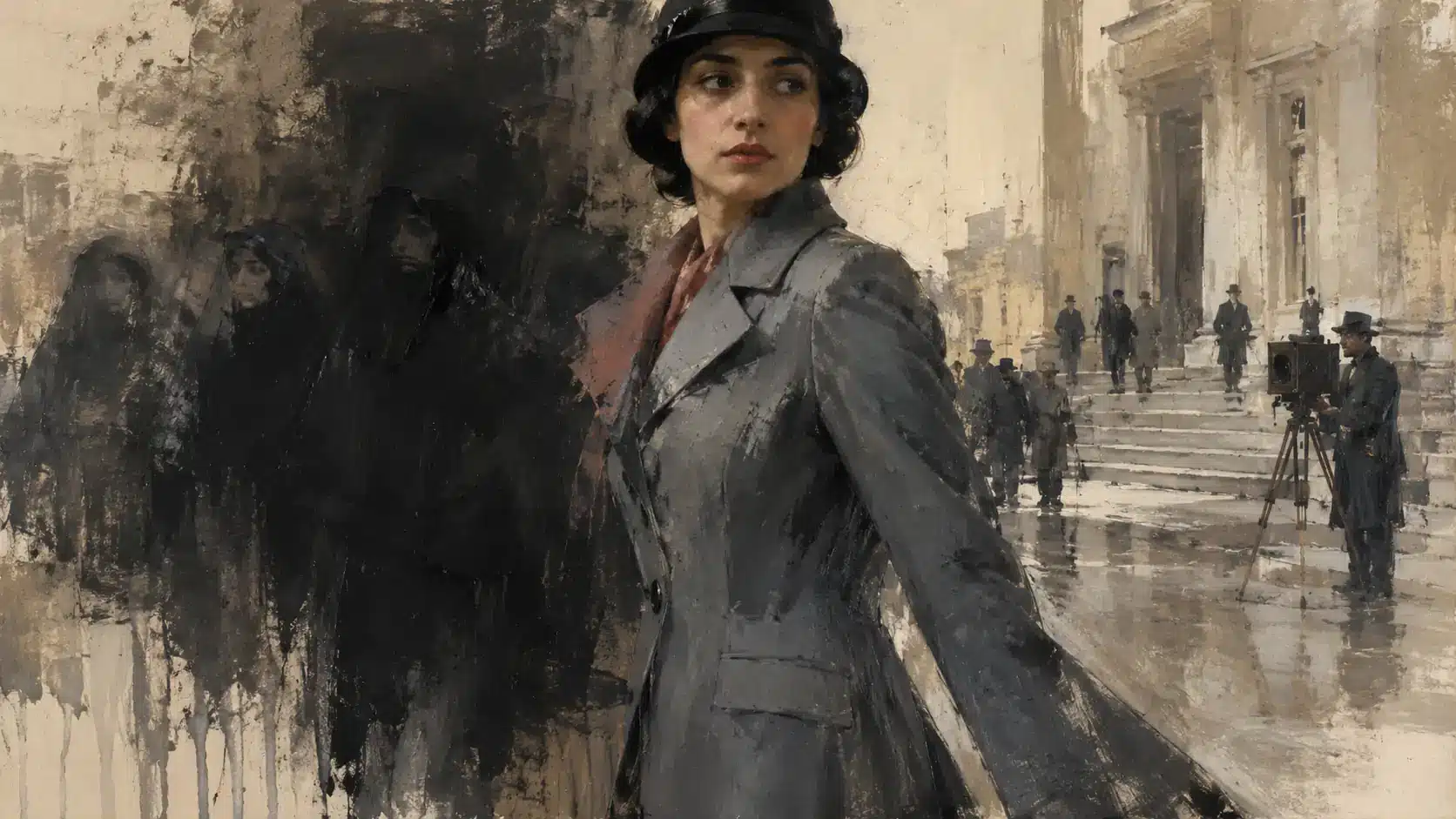
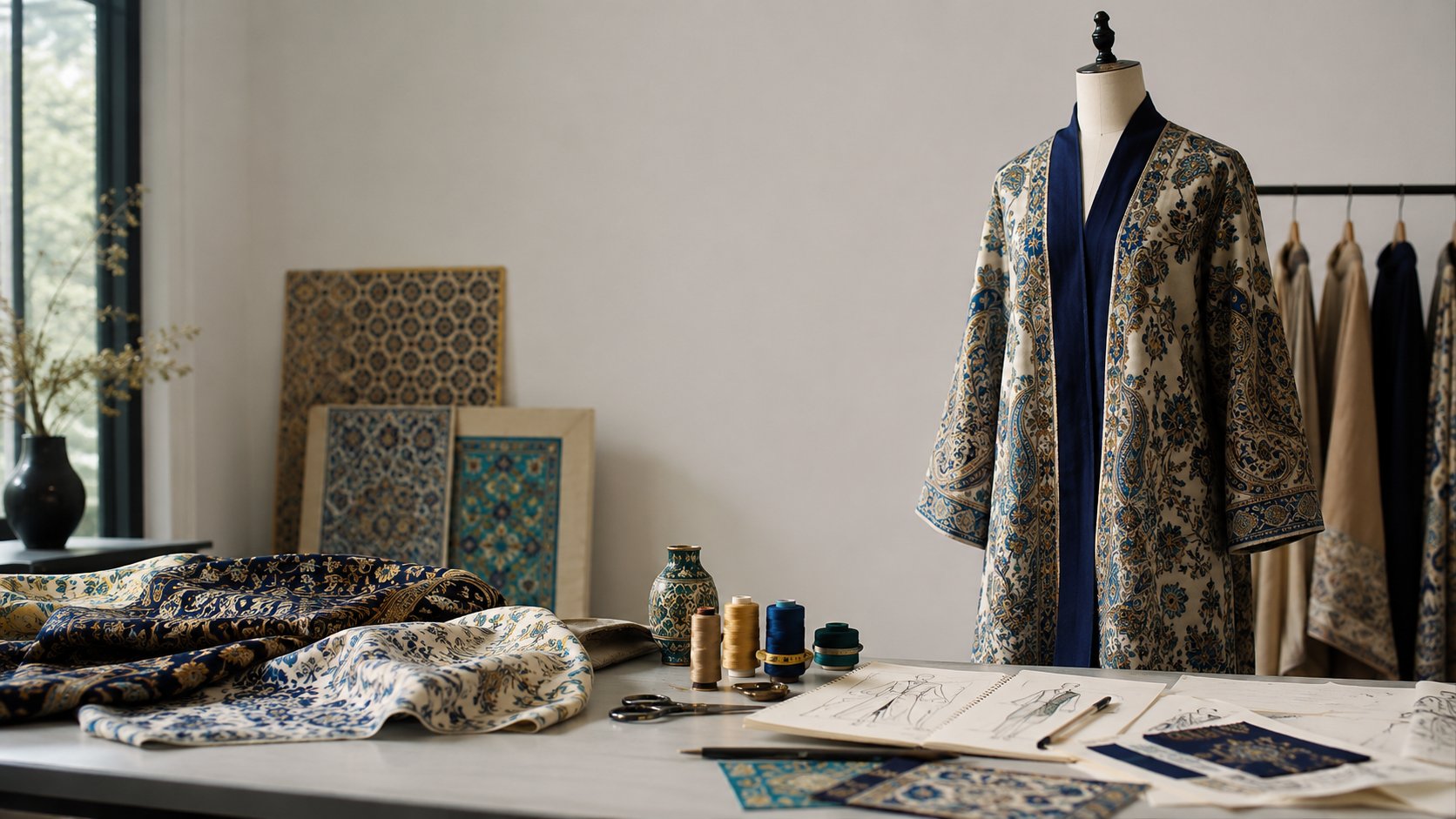
The visual atmosphere here is contemporary rather than antiquarian: graphite, clay, muted gold, ivory, and deep pomegranate. These colors suggest a design studio where historical fabric fragments, digital mood boards, pattern tests, and market notes sit on the same table.
The Archive Is Not a Style Closet
A serious reading of Iranian fashion begins with one caution: heritage should not be reduced to a decorative library. Iranian textile history is too technically rich, too regionally diverse, and too socially layered to be flattened into a few recognizable signs. The contemporary designer who uses a historical motif faces a double task. The first is aesthetic: how can an inherited form be made fresh without losing its structural dignity? The second is ethical: how can a motif be used with knowledge rather than extraction?
The historical field is wide. Sasanian textile debates remind us that some motifs survive more securely through reliefs, metalwork, stucco, and later interpretation than through abundant surviving garments. Encyclopaedia Iranica’s discussion of Sasanian textiles is useful precisely because it shows how cautious one must be when moving from ancient visual evidence to modern design claims. Later periods offer different kinds of evidence. Safavid silk, Qajar termeh, embroidered covers, printed cottons, court portraits, and museum-held garments provide more visible material trails, but even there the designer must distinguish between motif, technique, social use, and later revival.
For contemporary Iranian fashion design, the strongest historical dialogue often happens between Safavid luxury surface, Qajar textile exuberance, regional embroidery systems, and modern urban silhouettes. These references do not have to appear literally. A coat may carry the logic of a robe without copying its shape. A logo may echo the curvature of a boteh without becoming a souvenir. A textile print may borrow the discipline of a garden layout while using a minimal monochrome palette. Heritage, when handled intelligently, becomes grammar rather than costume.
Motif Translation Board
From Historical Sign to Design System
Motif as Surface
The most immediate use is print, embroidery, jacquard, appliqué, or beadwork. This can be beautiful, but it is also the easiest to mishandle. A surface motif needs scale, spacing, fabric compatibility, and a reason for being on that garment rather than another.
Motif as Cut
A curved boteh can become a sleeve line, a collar sweep, or an asymmetrical panel. A medallion can become a compositional center. The historical sign is not printed on the dress; it quietly organizes the architecture of the dress.
Motif as Brand Memory
For a fashion label, heritage can enter packaging, typography, campaign imagery, hangtags, and collection naming. The motif becomes a recognizable identity code, not a random seasonal decoration.
Historical Motifs and the Movement of Meaning
Iranian ornament travels through time by changing its function. A motif that once operated in a courtly robe may later appear in a domestic textile, then in a museum collection, then in a contemporary designer’s scarf or coat lining. Each stage changes the meaning. The same form can signal rank, craft, memory, taste, regional belonging, or cosmopolitan sophistication depending on where it appears and who reads it.
Safavid silk textiles are especially instructive because they show the close relationship between luxury cloth, political economy, literary imagination, and international circulation. The Metropolitan Museum of Art’s essay on silk textiles from Safavid Iran describes a world in which urban workshops, raw silk production, courtly patronage, and export markets were deeply connected. For a modern fashion designer, that matters because a textile is never only a pattern. It is also a system of labor, material, trade, prestige, and technical knowledge.
The Safavid robe, with its loose layering, belted structure, and luminous patterned surface, offers a design lesson beyond historical costume. The Met’s discussion of fashion in Safavid Iran highlights how robes, chemises, trousers, sashes, headwear, and patterned textiles worked together as a complete ensemble. Contemporary fashion can learn from this compositional intelligence: a garment is not isolated from its layers, accessories, movement, and surface hierarchy.
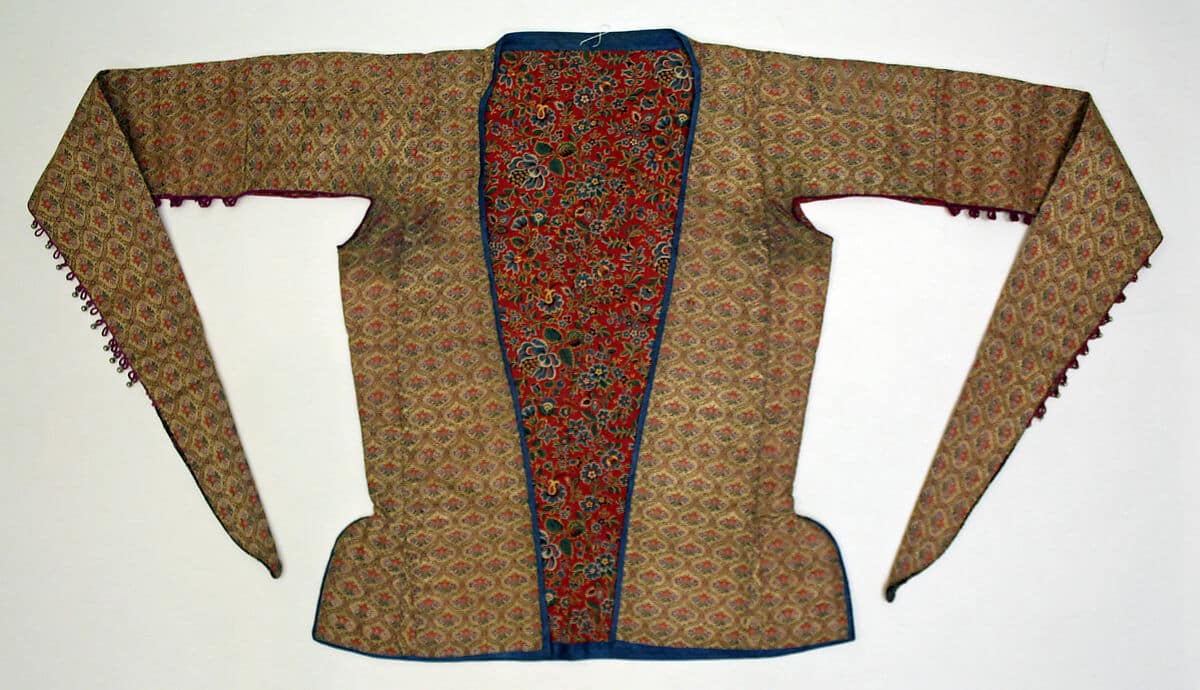
Qajar textiles add another register: heightened color, repeated floral fields, stamped cotton borders, brocaded silks, and embroidered surfaces. Encyclopaedia Iranica’s entry on clothing in the Safavid and Qajar periods is particularly valuable for understanding how fabrics, trims, linings, and repeat designs shaped the visual presence of garments. In contemporary design, these details can reappear not as literal reconstruction but as border placement, lining drama, edge treatment, contrast facing, or controlled ornamental density.
A Contemporary Palette
A Studio Atmosphere for Living Heritage
Ivory
archive paper
archive paper
Muted gold
thread memory
thread memory
Pomegranate
visual force
visual force
Graphite
urban restraint
urban restraint
Clay beige
earth and hand
earth and hand
This palette deliberately avoids a purely antique mood. Contemporary heritage fashion needs contrast: archival warmth, digital clarity, urban shadow, and metallic memory. The result should feel like a designer’s table after a museum visit, not like a costume display.
The Boteh, the Cypress, and the Problem of Recognition
Some motifs are recognized so quickly that they become dangerous for designers. The boteh is the clearest example. Internationally familiar through the paisley form, it can easily become a shortcut for “Persian-inspired” design. Yet its strength lies in its instability: it can read as flame, leaf, seed, cypress, tear, or vegetal curve. A sophisticated designer does not simply enlarge the boteh and place it on fabric. The designer asks what kind of movement the form implies. Does it lean? Does it rotate? Does it repeat? Does it demand symmetry, or does it become more alive when displaced?
The National Museum of Asian Art’s object page for a late nineteenth-century termeh cloth from Yazd notes the prominence of the boteh in termeh and its revival in the nineteenth century. That single observation opens a design question: what happens when a motif already associated with revival is revived again? Contemporary fashion is often a second or third act of translation. The designer is not returning to an untouched origin; they are entering a chain of reinterpretations.
This is why scale is critical. A small boteh repeat may create rhythm and textile density. A large boteh placed across a coat front may become almost architectural. A fragmented boteh may read as abstraction, while a hand-embroidered boteh may emphasize labor and slowness. In branding, the same curve can be reduced to a mark, but the reduction must be intelligent enough to avoid cliché. Recognition is useful only when it leads the eye deeper.
Motif Reading Map
Six Ways Heritage Ornament Enters Modern Fashion
1. Border Logic
Historic textiles often use borders to control the eye. In contemporary garments, this can become cuff emphasis, hem framing, lapel contrast, scarf edging, or a disciplined placement print that gives the body a visual perimeter.
2. Medallion Centering
The medallion is not only a motif; it is a system of attention. Modern design can use centered ornament carefully, especially in eveningwear, accessories, or ceremonial pieces where frontal presence matters.
3. Garden Geometry
The garden can become a compositional grid: divided panels, mirrored paths, floral intervals, and architectural spacing. This is especially powerful in coats, long shirts, and digitally printed textiles.
4. Scripted Surface
Calligraphic rhythm can influence seam direction, print flow, or embroidery density without turning a garment into a literal manuscript page. The key is movement, not quotation.
5. Craft Signal
Embroidery, appliqué, and hand finishing can signal the time of the hand. For luxury and collectible fashion, visible labor may matter as much as the motif itself.
6. Abstracted Memory
The most mature heritage design may barely show the motif. It preserves proportion, rhythm, palette, or edge hierarchy while leaving literal quotation behind.
Modern Cut, Historical Surface
Contemporary Iranian fashion design is most convincing when cut and surface negotiate with each other. A heritage motif placed on a badly considered silhouette becomes decorative wallpaper. A strong silhouette with no material intelligence becomes generic minimalism. The interesting work happens between the two: a robe-like coat with modern shoulder discipline, a long tunic whose side slits echo older mobility, a scarf print that treats the border as a frame, or a jacket lining that reveals ornament only in movement.
This matters because historical Iranian dress frequently relied on layering, controlled looseness, and surface richness rather than the tight sculptural tailoring associated with some European fashion histories. Contemporary design does not need to imitate those garments, but it can learn from their spatial intelligence. Cloth can fall away from the body while still organizing status, gendered presentation, and aesthetic authority. Surface can be dense without being chaotic. Ornament can move with the garment rather than sit on top of it.
A designer working with heritage motifs should therefore ask practical questions. Is the fabric light enough for the motif to remain clear in motion? Does embroidery stiffen a sleeve where softness is needed? Does digital printing flatten a motif that historically depended on woven relief or metallic thread? Does the garment allow the wearer to inhabit the reference, or does it make the wearer look like a display device? These questions keep heritage design alive at the level of garment engineering.
Garment Anatomy Panel
How a Heritage Motif Can Shape the Whole Garment
A motif can become structure, not ornament.
This abstract panel suggests three levels of translation. The vertical side bands represent border logic: the old textile habit of giving edges visual authority. The central robe-like field suggests a modern coat or long tunic. The tilted boteh-like curve shows how a historical form can guide movement across the body rather than simply repeat across fabric.
For designers, this distinction is central. A motif placed everywhere may lose its force. A motif placed strategically can organize gaze, movement, and memory. Contemporary fashion becomes more refined when it treats ornament as composition.
Museum Sources, Designer Portfolios, and Responsible Inspiration
Museum collections are essential for designers, but they should be used as research environments rather than mood-board mines. A museum object page can reveal date, material, origin, dimensions, accession history, and sometimes exhibition context. Those details change the design conversation. A silk and wool termeh from Yazd is not interchangeable with a Safavid lampas fragment, a Qajar embroidered cover, or a regional garment. Each object carries a different material history.
The Smithsonian’s exhibition Fashioning an Empire is a useful model because it places textiles beside portraits and manuscript folios. That matters for fashion history: textiles were not abstract flat surfaces; they were worn, seen, gifted, traded, staged, and represented. A contemporary designer who studies only the isolated pattern may miss how cloth behaved on the body and in the social imagination.
Qajar material culture also teaches designers about the relationship between domestic craft, professional workshops, and elite display. Encyclopaedia Iranica’s overview of Qajar art and architecture includes valuable notes on embroidered textiles, qalamkārī, floral medallions, cypress trees, and professional craft production. A designer can draw from these histories without pretending that all motifs belong to one timeless national style.
Responsible inspiration means naming sources when possible, studying technique, understanding regional specificity, avoiding sacred or community-specific motifs when context is uncertain, and collaborating with living craft communities when a design depends on their knowledge. Heritage fashion should create continuity, not extraction. It should open work for makers, visibility for archives, and deeper literacy for wearers.
Market Intelligence
Why This Matters Now
For Designers and Brand Builders
Heritage motifs offer differentiation in a crowded fashion market, but only when supported by research, refined execution, and a clear design point of view. A brand that treats Iranian ornament as a serious visual language can build identity across garments, packaging, campaigns, and storytelling.
For Textile Artists
The archive provides systems of rhythm, density, edge, and repetition. Textile artists can reinterpret these systems through weaving, printing, embroidery, quilting, digital jacquard, or mixed media without being trapped by reproduction.
For Collectors and Art-Market Observers
Research-led fashion has stronger long-term value than trend-based ethnic styling. Provenance, craft collaboration, limited production, material quality, and cultural literacy can make contemporary garments more collectible.
For Curators and Museum Professionals
Contemporary fashion can help museums show that historical textiles are not dormant objects. Exhibitions that connect archival cloth to living design practice can expand audiences while preserving scholarly seriousness.
For General Readers
Understanding motif, cut, and textile history changes how one sees clothing. A scarf, coat, or embroidered panel becomes not merely beautiful but readable: a visual argument about memory, identity, and taste.
The Contemporary Designer’s Dilemma
The contemporary designer who works with Iranian motifs faces a productive tension. If the reference is too literal, the garment may look like heritage merchandise. If the reference is too hidden, the cultural intelligence may disappear. The solution is not a fixed formula but an editorial discipline: decide what the motif is doing. Is it organizing the silhouette? Is it signaling a material tradition? Is it creating a market identity? Is it honoring a craft lineage? Is it building a bridge between Iranian visual culture and international fashion vocabulary?
This dilemma is especially sharp in diaspora and global markets, where Iranian heritage can be read through desire, memory, politics, exoticism, nostalgia, or luxury. A designer must therefore control the frame. The best collections explain themselves visually before they explain themselves verbally. They show why a motif belongs to a particular cut, why a color is restrained or intense, why a border appears only at the cuff, why a lining carries the richest ornament, or why a campaign image uses archival reference without turning into theatrical reconstruction.
Heritage motifs have market power because they create narrative depth. But narrative depth cannot substitute for garment quality. Fabric weight, seam finishing, print registration, embroidery tension, drape, lining, comfort, and durability remain decisive. In serious fashion, memory must be made wearable.
Curator’s Note
How to Read a Contemporary Heritage Garment
Begin with the body. Where does the garment direct attention: shoulder, waist, sleeve, hem, back, neckline, or movement? Then look at the surface. Is the motif repeated mechanically, placed ceremonially, fragmented, enlarged, woven, printed, embroidered, or hidden? Finally, ask whether the historical reference changes the garment’s structure or merely decorates it.
A strong garment usually answers all three questions at once. It understands the archive, respects the maker, and gives the wearer a contemporary life. It does not ask the past to stand still. It lets the past move.
Conclusion: The Future of a Motif Is Its Transformation
Heritage motifs remain meaningful because they can change. If they were fixed symbols, they would belong only to archives. Their power lies in their ability to pass from woven silk to printed scarf, from robe border to jacket seam, from courtly surface to independent fashion label, from museum object to contemporary visual identity. The task is not to preserve every motif in its original form, but to preserve the seriousness of looking, making, naming, and translating.
For Iranian fashion design, this is a major opportunity. The archive is rich enough to support luxury fashion, independent design, textile art, academic research, museum programming, and collectible limited editions. Yet the opportunity depends on literacy. Designers must know the difference between Safavid silk and Qajar termeh, between regional embroidery and generalized ornament, between material technique and surface resemblance. Collectors and curators must also develop sharper language for contemporary garments that work with heritage without becoming replicas.
The most compelling future for Iranian heritage in fashion is neither nostalgic nor aggressively modern. It is intelligent, material, researched, and alive. It allows a motif to travel, but asks it to travel with memory.
Editorial Takeaway
A heritage motif becomes contemporary when it stops behaving like a borrowed image and begins to shape the garment’s structure, rhythm, material logic, and cultural voice. The future of Iranian fashion heritage depends on this movement from decoration to design intelligence.
Correspondence and Cultural Programs
For correspondence, discussion, collaboration, questions, event updates, cultural programs, and fashion-history conversations, readers are welcome to contact Heritage by Sanaz. The project welcomes thoughtful exchange with artists, designers, collectors, curators, researchers, and readers interested in Iranian clothing heritage.
Direct Message
For a direct and calm conversation about collaborations, programs, research interests, or fashion-history dialogue, you may also send a message on WhatsApp.
Send a direct WhatsApp message (+351914016396)